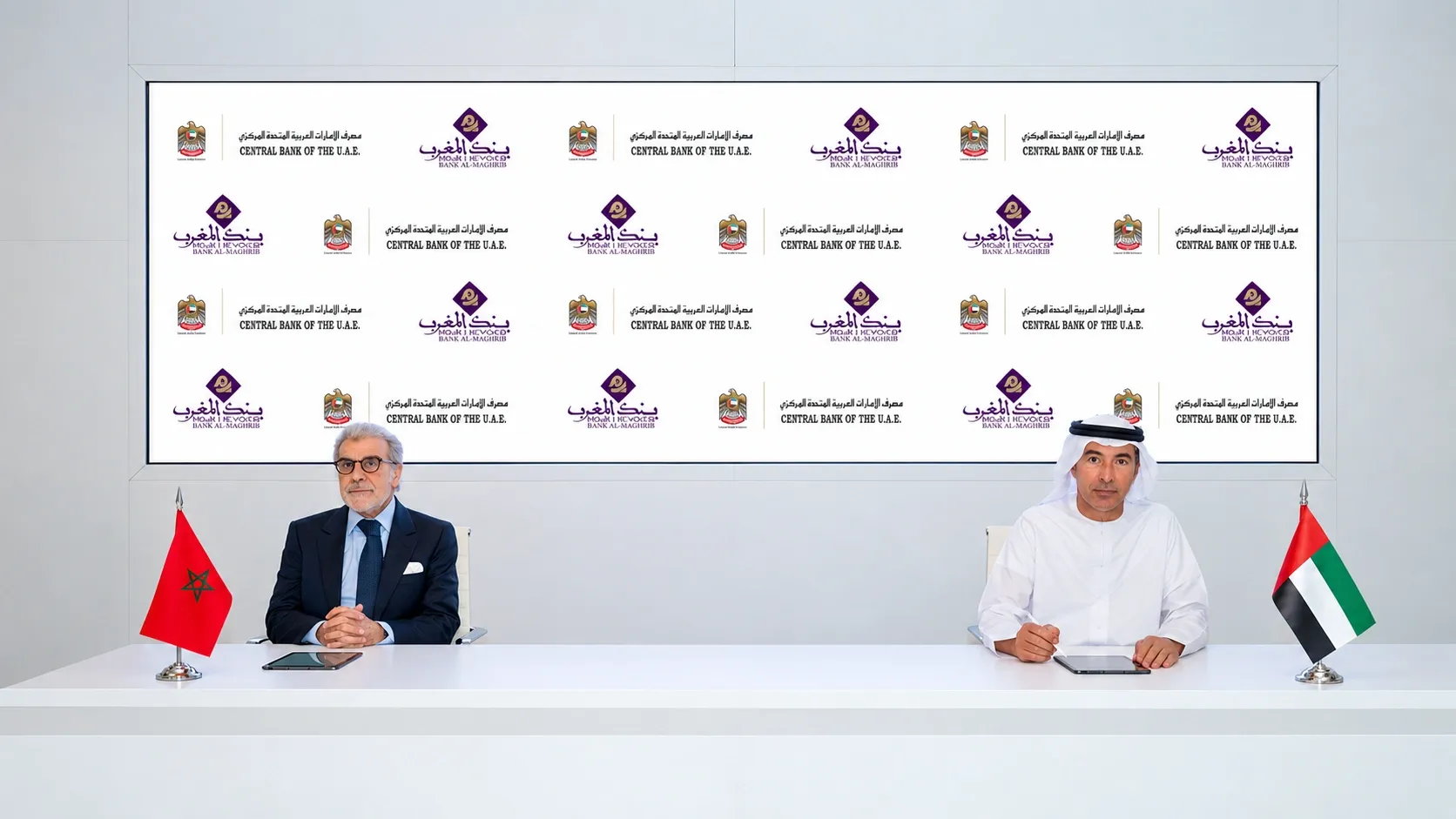
The United Arab Emirates and Morocco are exploring whether their domestic instant payment systems can be connected, opening discussions on how payments between the two countries could be processed and settled.
Khaled Mohamed Balama, governor of the Central Bank of the UAE, and Abdellatif Jouahri, governor of Bank Al-Maghrib, signed the memoranda of understanding at the UAE central bank’s headquarters in Abu Dhabi.
One agreement covers payment platforms, national card switches and financial messaging systems, including possible mutual acceptance of domestic payment cards. It also addresses central bank digital currencies, financial technology and regulatory cooperation on virtual assets, including stablecoins and consumer protection.
The other covers banking supervision, information sharing, institutional expertise and Islamic finance, including Shariah governance and cross-border trade and infrastructure financing.
Khaled Mohamed Balama, Governor of the CBUAE, said: "Through this cooperation, we look forward to exchanging supervisory expertise, developing Islamic finance solutions, and exploring opportunities to strengthen links between payment systems, contributing to a more efficient and innovative financial sector and supporting economic and trade relations between the two countries.”
Abdellatif Jouahri, Governor of Bank Al-Maghrib, added: "the two MoUs mark an important step in consolidating the partnership between Bank Al-Maghrib and the Central Bank of the UAE, and expanding coordination in supervision, regulation and Islamic finance. This partnership also opens up opportunities to develop cross-border financial transactions and accelerate their processing, and to explore ways to use central bank digital currencies in payments between the two countries, contributing to greater efficiency in financial transactions and stronger cooperation between the two institutions."
Domestic Infrastructure Provides a Starting Point
The UAE already has a domestic instant payment platform. Al Etihad Payments, a subsidiary of the UAE central bank, launched Aani in October 2023 under the Financial Infrastructure Transformation program. Its launch announcement described a service operating around the clock for consumers, businesses and government entities.
Aani’s initial functions included transfers using a recipient’s phone number, requests for money, bill splitting and QR-code merchant payments. Access was available through participating financial institutions’ channels or the Aani mobile application. Those features illustrate the domestic services from which a cross-border connection could develop.
The central bank’s 2024 annual report separately describes Jaywan, the UAE’s domestic card scheme, and its role in processing local debit-card transactions within the country. Instant account payments and card payments thus involve different infrastructure, even when both are included in a broader cooperation agreement.
That report also documents UAE participation in regional payment arrangements, including the GCC’s AFAQ system and the Arab Regional Payment System, Buna.
International payment-system work shows why connecting domestic networks involves decisions beyond software. A 2024 report from the Committee on Payments and Market Infrastructures, hosted by the Bank for International Settlements, identifies governance and oversight as central challenges for fast payment links spanning jurisdictions and currencies.
Operators must consider the legal structure, ownership and operating arrangements of a connection, along with who governs it and how stakeholders participate. These choices determine responsibility for a service that depends on systems operating under different national frameworks. They also shape how the participating institutions organize decisions and manage risks.
Supervisors face a related task: deciding how oversight of the individual domestic systems fits with oversight of their shared connection or any separate operating entity. The committee’s report sets out recommendations intended to help authorities and operators address these questions when designing an arrangement.
This is broader international guidance, rather than a published blueprint for the UAE-Morocco project. It explains the work that typically sits between an agreement to investigate a link and a functioning service. Technical compatibility is one requirement; an agreed structure for operating and supervising the connection is another.
The potential appeal is straightforward: extending the convenience of domestic instant payments across borders. In an October 2024 release, the payments committee said interlinking could bring faster, more accessible and more transparent payments to international transactions. It presented those benefits as possibilities, rather than automatic outcomes.
The same release highlighted financial messaging standards and application programming interfaces, which allow systems to exchange information. Fragmented interface standards can increase processing time, expense and errors. More consistent approaches can help networks communicate, but the release also acknowledges the difficulty of arranging governance across currencies and jurisdictions.