@2026 Finance News International. All Rights Reserved.

Blends Media
A Blends Media Group Production

Norway Tops the Ranking of the World’s Largest Sovereign Wealth Funds

Staff Writer
Staff Writer
Oct. 05, 2026
Sovereign Wealth FundsSovereign wealth funds manage government-owned assets under mandates that can include long-term savings and domestic economic development. (Shutterstock)

Norway’s sovereign wealth fund holds more assets than Saudi Arabia’s Public Investment Fund, Qatar Investment Authority and Singapore’s Temasek combined, according to Global SWF’s October 2026 ranking. The comparison places the Norwegian fund at approximately $2.28 trillion and underscores the scale of a savings pool built from petroleum revenue and decades of investment.

The research firm lists Norges Bank Investment Management, which manages Norway’s Government Pension Fund Global, at $2.284 trillion. Its figures put PIF at $906 billion, QIA at $580 billion and Temasek at $401 billion. TThe three institutions total $1.887 trillion, leaving Norway ahead by $397 billion, or about 21%, based on calculations from the ranking.

Those numbers describe portfolio size, rather than annual profits or money immediately available for government spending. They also do not establish which institution has delivered the strongest investment performance. Each manages a different mix of assets and operates under its own mandate, making the headline comparison a measure of financial scale.

Global SWF says it uses the latest available dollar figures and estimates where those figures are unavailable.

Norway’s official half-year announcement reported a 9.4% investment return during the first six months of 2026. NBIM attributed the result primarily to stock-market gains, particularly in Asian technology companies. The fund exceeded its benchmark return by 0.22 percentage points during the period.

Equities represented 72.1% of the portfolio, while fixed-income investments accounted for 25.8%. The remainder comprised unlisted real estate, at 1.6%, and unlisted renewable-energy infrastructure, at 0.5%. Consequently, movements in publicly traded stocks and bonds account for much of the change in the fund’s overall value.

Performance varied across those holdings. Equities returned 13.0% in the half-year, compared with 0.9% for fixed income and 3.0% for unlisted real estate. Renewable-energy infrastructure returned negative 0.2%. The results show that the overall gain did not extend evenly across every part of the portfolio.

Currency movements also affected the accounts. NBIM reported that a stronger Norwegian krone reduced the portfolio’s value when overseas holdings were translated into its reporting currency. Its half-year report measures investment performance primarily against a basket of international currencies, another reason to separate investment returns from changes in a dollar-denominated ranking.
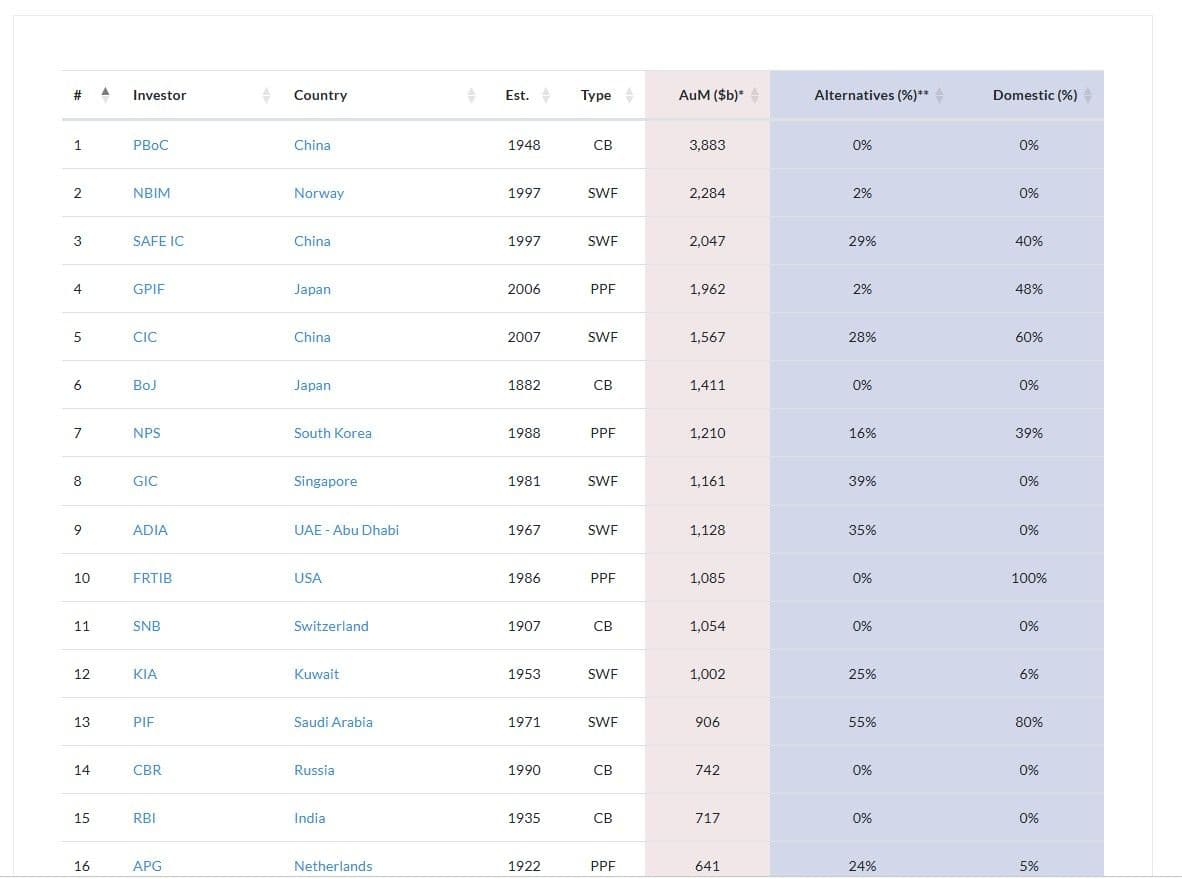

RankingThe world’s largest sovereign wealth funds differ in both portfolio size and investment priorities. (Image source: Global SWF)

Norway’s fund was established to manage the economic consequences of petroleum income and preserve wealth for future generations. Parliament passed the legislation creating its predecessor in 1990, and the first deposit followed in 1996. Under the framework described by NBIM, its investments are made outside Norway.

PIF combines international investing with a domestic development role. In its 2025 results announcement, the Saudi fund reported assets under management above $900 billion. It also described a strategy for 2026–2030 centered on domestic economic ecosystems alongside strategic and financial portfolios. Its responsibilities therefore extend beyond maintaining an overseas savings portfolio.

QIA’s official mandate includes generating long-term value, supporting economic development and providing liquidity when needed to stabilize Qatar’s economy. Established in 2005, it invests across markets, sectors and asset classes. The $580 billion figure used in the comparison comes from Global SWF’s ranking, rather than an asset total confirmed in the QIA disclosures reviewed for this article.

Temasek describes itself as a global investment company. Its announcement reported a net portfolio value of $401 billion (S518 billion) as of March 31, 2026, measured on a mark-to-market basis.

The Norwegian portfolio also has a direct connection to public finances. Budget surpluses can be transferred into the fund, while withdrawals help cover deficits. NBIM explains that this arrangement allows petroleum wealth to support government spending over time, rather than tying expenditure solely to the oil and gas income received in a particular year.

Norway’s fiscal framework links withdrawals over time to the fund’s expected real return, estimated at approximately 3% annually. The rule is intended to phase petroleum revenue gradually into the economy while preserving the savings base. It is a spending guideline, not a promise that financial markets will deliver the same return every year.

The comparison with PIF, QIA and Temasek captures the size of that accumulated portfolio. Its future dollar value will continue to change with asset prices, exchange rates and government transfers. This comparison provides a documented snapshot of Norway’s lead, while the gap between the four institutions can change over time.