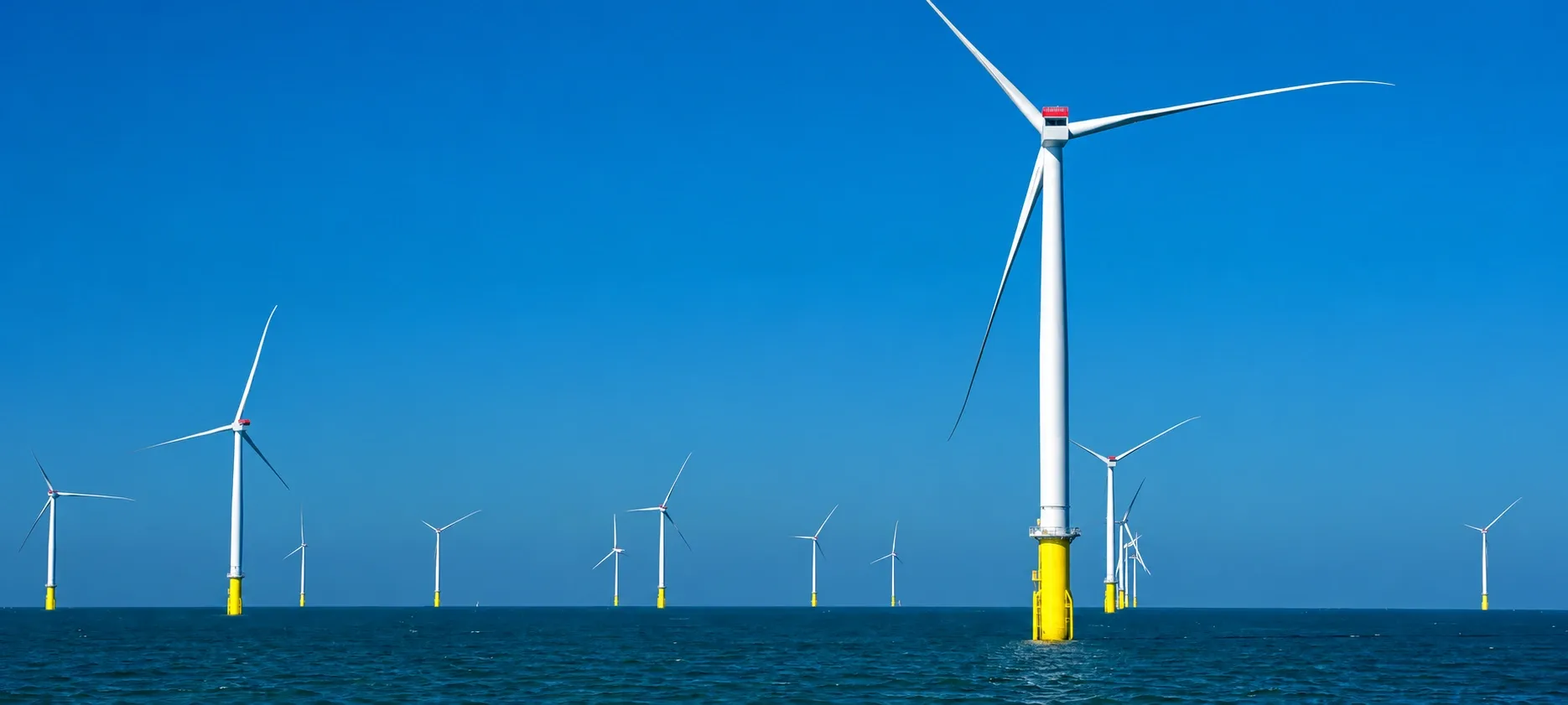
Abu Dhabi, United Arab Emirates — Abu Dhabi clean energy company Masdar has raised $600 million through its first blue bond, a five-year note whose proceeds are earmarked for offshore wind and other renewable energy projects at sea.
S&P and Fitch both rate the bond AA-. On Masdar's account, no corporate issuer anywhere has yet brought a public blue bond to market with a higher rating. The deal is the company's fourth bond overall and the first blue issue under its $6 billion Global Medium Term Note Programme.
Orders peaked at $1.5 billion, leaving the deal 2.5 times oversubscribed. Masdar, whose legal name is Abu Dhabi Future Energy Company PJSC, said regional and international investors of many kinds took part despite challenging market conditions, and it read the response as a vote of confidence in its financial resilience and strategy.
The notes were listed on the International Securities Market of the London Stock Exchange and pay a 5.875% coupon in US dollars. Masdar then swapped the proceeds into euros at a yield of 4.374%, which the company said matches its funding with its investment exposure in Europe.
That currency choice follows the company's recent deal flow. Masdar completed its takeover of Greek renewable energy developer TERNA ENERGY in April 2025, and it has since agreed to acquire a solar project of more than 550 megawatts in Greece. Borrowing in euros against assets of that kind could reduce the currency risk on its European investments.
The blue label rests on a change Masdar made last month to its Green Finance Framework (GFF), which now lists eligible blue projects among the activities its sustainable debt can fund. Such projects have to support the sustainable use of oceans and water resources, and each must pass a full impact assessment intended to limit harm to biodiversity.
Blue bonds are a branch of the green bond market. A practitioner's guide published in September 2023 by the Asian Development Bank and the International Finance Corporation (IFC), with contributions from the International Capital Market Association (ICMA), describes them as green bonds focused on the sustainable use of maritime resources and related economic activities.
Masdar said its updated GFF follows the blue guidance of ICMA and the IFC. Moody's has again given the framework an SQS1 (Excellent) Sustainability Quality Score, the top grade on that scale.
Mazin Khan, Chief Financial Officer of Masdar, said: “For two decades, Masdar has been a driving force in the development, deployment and commercialization of renewable energy solutions across the world. Our first blue bond issuance under our updated Green Finance Framework provides yet more opportunities for investors to join us in building the clean energy system of the future. This benchmark offering will ensure capital can be delivered where it will have the most impact, supporting the development of a more resilient blue and green economy.”
Before this deal, Masdar had raised $2.75 billion through its bond program since 2023, and the new issue lifts that total to $3.35 billion. By the end of 2025, $2.3 billion of the money had gone to 30 renewable energy projects in 10 countries with a combined gross capacity of more than 16 gigawatts, the company said.
Its previous issue, a $1 billion green bond in May 2025, came in two $500 million tranches of five and 10 years with coupons of 4.875% and 5.375%. That deal drew a peak orderbook of $6.6 billion and was rated AA- by Fitch and A1 by Moody's. It followed green bonds of $750 million in 2023 and $1 billion in 2024.
The blue bond's 2.5 times cover is lower than that 2025 result, although Masdar pointed to tougher market conditions this time and the new issue is smaller. Abu Dhabi Commercial Bank, BNP Paribas, Crédit Agricole CIB, First Abu Dhabi Bank, HSBC, J.P. Morgan and Société Générale CIB were among the joint lead managers and bookrunners.
Masdar's portfolio now exceeds 65GW in established and fast-growing renewable energy markets, covering solar, onshore and offshore wind, battery storage and hybrid projects. The company said it will keep expanding through disciplined investment in strategic markets, supplying reliable and affordable clean power as electricity demand climbs and supporting energy security and economic growth, on what it calls a clear path to 100GW of capacity by 2030.