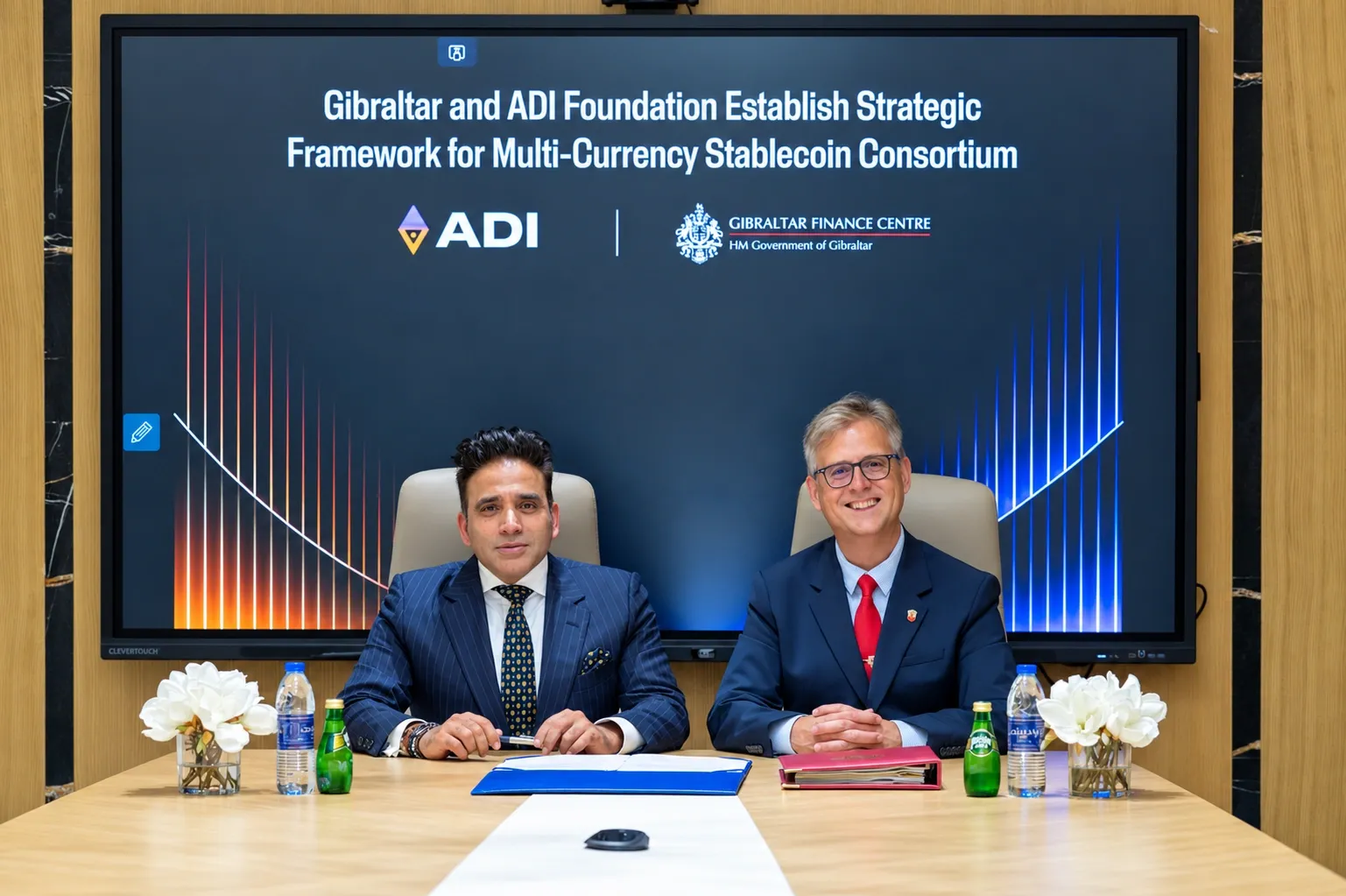
Abu Dhabi, United Arab Emirates — Abu Dhabi blockchain infrastructure provider ADI Foundation and His Majesty’s Government of Gibraltar have agreed to study a consortium that would issue fully reserved stablecoins tied to sterling, the U.S. dollar and the euro, using ADI Chain as the issuance layer.
The two sides signed a memorandum of understanding, which commits them to explore the idea rather than launch any token. They described the agreement as a significant step toward regulated digital financial infrastructure that links international markets.
Under the MoU, ADI Foundation will look further at forming the group with founding members drawn from banks and other institutions that hold Gibraltar licenses. ADI Chain would provide the infrastructure to issue the coins. The foundation calls the network the first sovereign digital infrastructure in the GCC and MENA region built for governments and institutions.
Each currency would sit in its own issuing entity. Reserves would match the coins in circulation one-for-one and be held in high-quality liquid assets in the same currency as the coin, with independent attestation and a yearly audit. The partners intend ownership to be open and equitable, shared fairly between ADI and whichever founding members take part.
The project’s stated focus is putting digital money on-chain at institutional scale and making Gibraltar the home of a responsibly run, fully reserved stablecoin referenced to a currency, sterling included, under the territory’s own rules. Gibraltar became the first jurisdiction to bring in a purpose-built regulatory framework for distributed ledger technology in 2018, the release said.
Issuance is only part of the design. The partners also want the coins to support settlement between institutions, cross-border payments and international trade, and they see a longer-term chance to connect Europe with Africa. That plan draws on the foundation’s existing joint venture with the Secretariat of the African Continental Free Trade Area (AfCFTA), which is building digital trade infrastructure across AfCFTA member states.
Ajay Bhatia, Principal Council Member at ADI Foundation, said: “This is bigger than launching another stablecoin. Our ambition is to explore building a regulated financial infrastructure that allows digital money to move seamlessly between institutions, markets and economies. Gibraltar brings a sophisticated financial ecosystem and pioneering experience in DLT, while ADI brings the infrastructure and international network. Together, we are exploring building the foundations for a new digital settlement bridge connecting Europe, the Middle East and Africa.”
Nigel Feetham KC MP, Gibraltar’s Minister for Justice, Trade and Industry, added: “For the past nine months, we have been actively engaged in an international outreach programme, connecting with leading digital-finance businesses and investors, including at major industry events around the world. Our aim has been clear: to strengthen Gibraltar’s position at the forefront of digital innovation. The Stablecoin Project represents an exciting opportunity for Gibraltar and is another important step in our efforts to foster innovation and attract investment. It builds on recent legislative initiatives, including a world-first bespoke prediction market regime and legislation facilitating tokenised fund shares and DLT-based share registers, alongside further legislative developments currently underway, and reinforces Gibraltar’s position as a leading international centre for the digital economy.”
Feetham signed the agreement during a visit to the UAE, describing Abu Dhabi as a major international investment center with strong links across the Middle East, Europe and Africa. The minister said the outreach aims to diversify Gibraltar’s economy and reduce its reliance on UK-facing business, particularly following the impact of the UK gambling tax.
He returned to the deal a week later at the Gibraltar Day in London New Technologies event, where panels covered stablecoin use in payments, remittances and foreign exchange, along with the first licenses issued under Gibraltar’s prediction market law. Feetham described the ADI agreement there as another step in the effort to keep Gibraltar competitive as digital finance evolves.
On the ADI side, the stablecoin model is already in use at home. ADI Chain serves as settlement infrastructure for DDSC, a dirham-backed stablecoin that holds a Central Bank of the UAE license and was started by IHC, Sirius International Holding and First Abu Dhabi Bank (FAB). The foundation calls ADI Chain the MENA region’s first institutional blockchain built for stablecoins and real-world assets.
Sirius International Holding, the technology arm of International Holding Company, founded ADI, which is based in Abu Dhabi Global Market (ADGM). The foundation presents itself as a gateway that helps public and private sector organizations adopt blockchain through policy-aligned infrastructure, with the goal of connecting one billion people and institutions to the digital economy by 2030. It names BlackRock, Mastercard, M-Pesa, Visa and Franklin Templeton among the institutions it works with.
The Africa link has its own timeline. The AfCFTA Secretariat and ADI Foundation signed the strategic partnership agreement behind that venture in New York on July 18, 2026. It targets cuts of up to 90% in the cost of settling cross-border payments, with corridor pilots due from late 2026 and plans to raise over $1 billion from institutional, development-finance and private investors.
The Gibraltar talks also follow an MoU with Dubai platform Tokinvest earlier this month that aims at a $100 million tokenized Sukuk built from existing Sukuk of UAE issuers.
If the consortium goes ahead, Gibraltar-licensed banks could become co-owners of the issuers rather than only distributors of other firms’ coins. The separate entity for each currency and the annual audit may also weigh with institutions assessing the reserves behind any token.