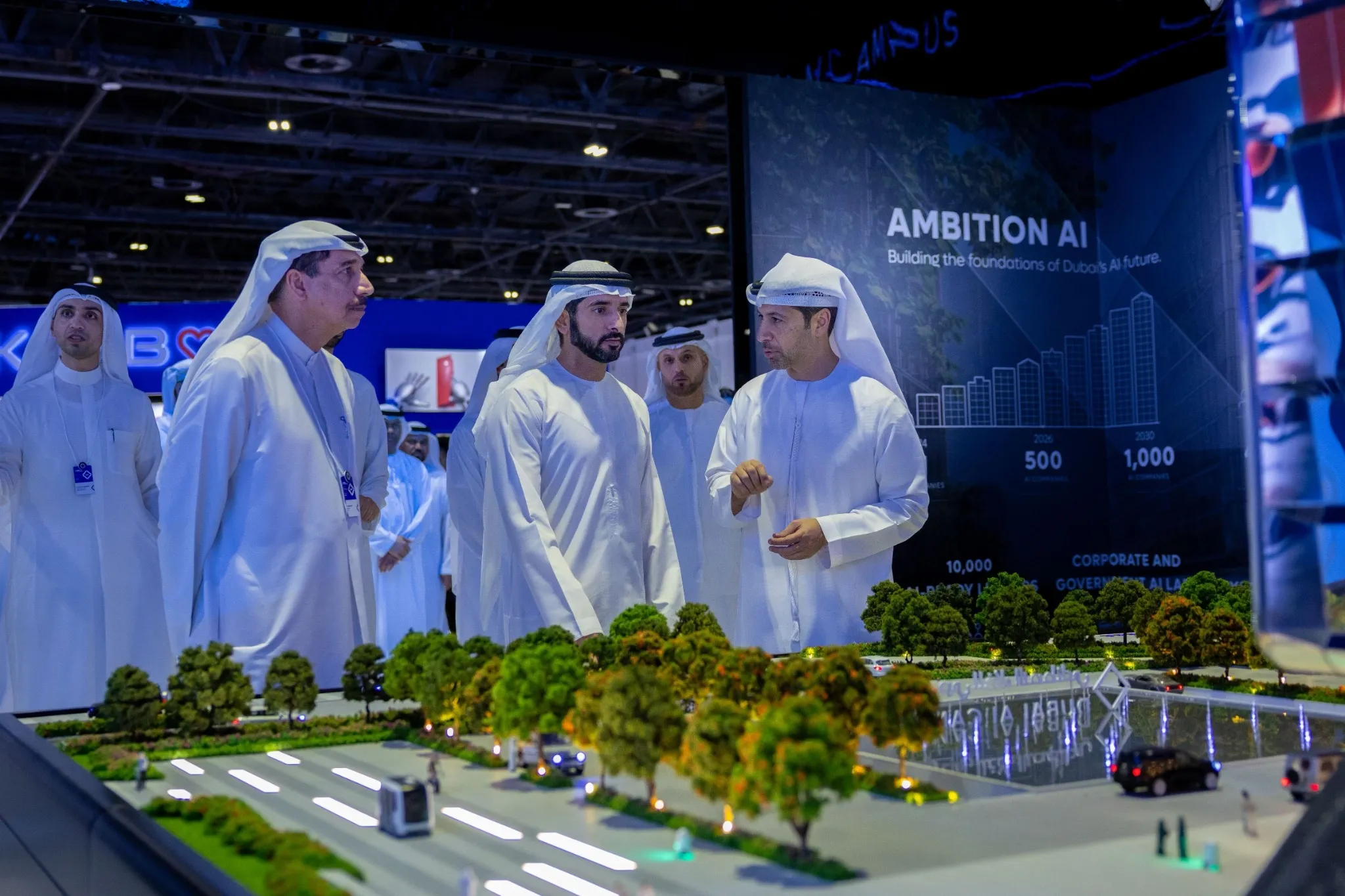
Dubai, United Arab Emirates — Dubai's Crown Prince, Sheikh Hamdan bin Mohammed bin Rashid Al Maktoum, has signed off on new goals for Dubai AI Campus, the artificial intelligence cluster run by the Dubai International Financial Centre (DIFC), which now aims to host more than 1,000 AI companies and over 5,000 highly skilled jobs by 2030.
He approved the targets while attending the opening of the third Dubai AI Festival at Dubai World Trade Centre. Sheikh Hamdan, who also serves as the UAE’s deputy prime minister and minister of defense, chairs the Dubai Future Foundation’s Board of Trustees and the Higher Committee for Future Technology and Digital Economy.
Arif Amiri, chief executive officer of DIFC Authority, briefed him on the campus’s progress. The campus exceeded its original five-year targets for company numbers and investment two years ahead of schedule.
Since opening in May 2024, the campus has signed up more than 500 AI firms. Between them, those companies have raised over $272 million (AED 1 billion) from venture capital and private equity investors, and DIFC credits the campus with helping to create more than 2,000 specialized technology jobs.
Sheikh Hamdan commended the progress and said the next stage should build on it, with the government and private companies working more closely to find new sources of growth. In the release, DIFC said the higher goals are meant to cement the campus's standing as a global destination for specialized AI talent.
In his remarks, the Crown Prince said Dubai continues to invest proactively in promising sectors and advanced technologies to create opportunities for economic growth, guided by the vision and directives of Sheikh Mohammed bin Rashid Al Maktoum, the UAE’s vice president and prime minister and ruler of Dubai. He said: “Artificial intelligence has become one of the world's most significant drivers of technological and economic progress.” He also highlighted its potential to transform businesses and develop innovative solutions.
He added: “Our priority is to position Dubai at the forefront of adopting advanced technologies by providing state-of-the-art infrastructure, a flexible regulatory environment and access to the world's best talent and expertise. This will enable companies and innovators to develop AI technologies and translate their potential into sustainable economic value.”
He also singled out DIFC's part in delivering that plan. The financial center, he said, puts innovators, investors, tech companies and international institutions side by side in one connected setting, which in turn adds to Dubai's standing as a leading hub for technology and innovation.
The visit included a look at the design and development plans for a new Dubai AI Campus building in DIFC Zabeel District, the expansion area of the financial center. DIFC describes the 100,000-square-foot project as the first building anywhere designed specifically for this purpose, and says it will act as the main base for AI development and innovation in a city it presents as a living laboratory for an AI-driven economy.
The building will gather the facilities, specialist knowledge and resources that companies need to move faster on AI innovation, adoption and commercialization, feeding into Dubai's goal of becoming a leading global center for the AI economy by 2030. The technical specification lists digital twin environments, secure AI development zones, GPU-ready systems and AI-powered building systems.
Floors are planned to be modular and ready for laboratory use. They will hold AI Labs in which private companies and government bodies can build, test in pilots and validate AI tools before releasing them more widely, while dedicated conference space will be used for summits, policy debates and thought leadership sessions all year.
A public-facing AI Experience Centre will present the newest AI applications from a range of sectors, drawing on the AI Labs, companies based at the campus and pilot projects running across Dubai. Residents, students and visitors will be able to use it, as will investors and official delegations. DIFC said the facilities together will give businesses, government, investors, skilled workers and the general public a shared space to build, test and roll out AI in the city. The release gives no construction timeline or budget for the building.
Essa Kazim, Governor of DIFC, said: “The continued growth of Dubai AI Campus and the development of its new purpose-built facility in DIFC Zabeel District will further strengthen Dubai's position as a global leader in AI and the technology economy.”
Amiri, Chief Executive Officer of DIFC Authority, said: “Our ambition is not simply to integrate AI into DIFC, but to reimagine how a financial centre operates in the age of AI, with responsibility, security and trust as its foundations. Dubai AI Campus has already achieved its 2028 target of attracting 500 AI companies two years ahead of schedule, and we are now raising our ambition to more than 1,000 companies and over 5,000 jobs by 2030.”
The campus sits inside a broader DIFC plan. In April, the center said it intended to become what it calls the world's first AI-native financial center, a change it estimated could add $3.5 billion (AED 12.9 billion) to the emirate's economy and bring roughly 25,000 jobs.
Kazim received Sheikh Hamdan when he arrived at the venue. Dubai AI Campus, which is part of DIFC, runs the festival together with the Office of the Minister of State for Artificial Intelligence, and this year's event uses the theme ‘Where Intelligence Meets Opportunity’ to examine how AI adoption moves into its next phase. The festival closes on October 27.
Organizers report more than 20,000 attendees from over 100 countries, including policymakers, entrepreneurs and technology executives. More than 150 people are speaking, and the event counts 500 investors and 200 exhibitors. Ten space and AI scale-ups chosen by DIFC were also due to show proofs of concept there, after the center matched them with five UAE organizations for geospatial pilots.
Husni Khuffash, Positron AI’s managing director for the Middle East and Africa, is among the festival’s featured speakers. Positron AI, a U.S. maker of AI inference systems, opened its first base outside the United States in DIFC earlier this year.