
@2026 Finance News International. All Rights Reserved.

Blends Media
A Blends Media Group Production

NVIDIA Unveils DSX POD for AI Factory Deployment in as Little as 14 Days

Arry Hashemi
Arry Hashemi
Oct. 27, 2026
NvidiaNVIDIA says its factory-built DSX POD modules could shorten AI infrastructure deployment at a prepared site from six months to as little as 14 days. (Shutterstock)

Berlin, Germany — NVIDIA has unveiled DSX POD, a reference design under which partners build complete Vera Rubin AI factories inside modular containers, an approach the chipmaker says can bring a prepared site into operation in as little as 14 days instead of six months.

The design was presented at NVIDIA's GTC Berlin conference. Partners assemble and test each unit before it ships, and the containers are meant to plug straight into the power, cooling, networking and other supporting systems already waiting at the customer's site.

The main change is where the work happens. Computing equipment, networking, cabling, rack-level power and liquid cooling are integrated at the manufacturing plant rather than on location, which NVIDIA says removes much of the planning, construction, specialized labor and logistics that a traditional onsite build demands.

Testing the containers at the factory also limits exposure to component delays and to expensive, error-prone work in the field, the company said. In its view, that gives customers a quicker route to training models and running production inference, and therefore to generating tokens and revenue.

Jensen Huang, founder and CEO of NVIDIA, said: “An AI factory creates value when it starts producing tokens — not when construction is complete,” adding: “With NVIDIA DSX POD, we’re bringing factory-built precision and speed to AI infrastructure construction — reducing deployment time from months to weeks so customers can scale capacity and bring revenue-generating production online faster.”

NVIDIA describes DSX POD as a way of combining Vera Rubin systems with the supporting equipment they rely on, in standardized, repeatable container designs that partners can manufacture and ship in volume.

The design follows the thinking behind NVIDIA's wider DSX infrastructure platform but has its own architecture, in which systems are integrated and validated inside purpose-built containers before transport. Partners finish the rack-to-rack cabling, wiring, piping and functional testing before a unit leaves the plant. Because that work runs separately from site preparation, the two can proceed at the same time.

NVIDIA links the speed claim directly to revenue. Its term for that moment is time to first token: the point at which a new AI factory starts serving production workloads and the operator can begin earning from the hardware.
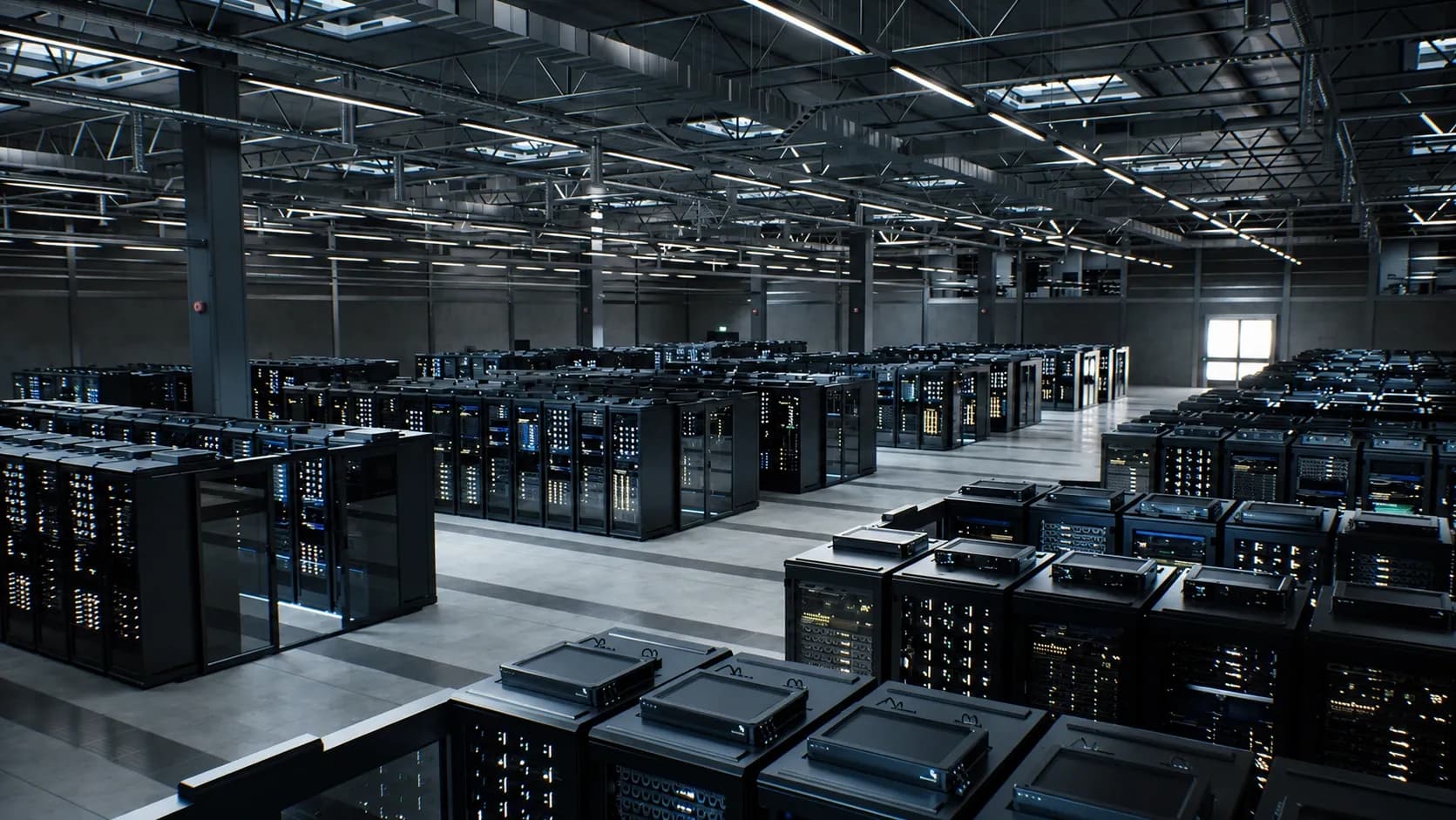

Nvidia 2NVIDIA is working with 17 partners to deliver modular AI factories with computing, power and liquid cooling integrated before shipment. (Shutterstock)

The launch came alongside a separate release in which NVIDIA described its broader DSX platform as a full-stack AI factory reference architecture, with compute, networking, storage, software, power and cooling designed as a single system. The company says its DSX MaxLPS software can cut the power an operator needs for a given token output by up to 30%.

That release also says DSX designs that pair closed-loop liquid cooling with dry coolers could save 54 million liters of water a day at a 2-gigawatt deployment, compared with conventional cooling towers. G42 is among the cloud partners exploring new components of NVIDIA's DSX OS infrastructure-management software, according to the company.

Denver-based Crusoe, one of the DSX POD partners, said the same day that it will build its Crusoe Spark modular units to the new reference design. The company has built and operated modular AI factories since 2020 and plans to mass-produce units at a new 352,000-square-foot factory in Brighton, Colorado. It also unveiled Crusoe Spark Liquid, a sixth-generation module built for dense systems such as Vera Rubin NVL72.

Bryan Schramm, Head of Spark for Crusoe, said: “Modular isn't a new strategy or pivot for us. It’s been in our DNA since our founding,” and went on: “We’ve spent six years building, operating, and refining modular data centers in some of the most demanding environments on Earth. NVIDIA DSX POD establishes an important standard for the industry, and Crusoe brings nearly a decade of operational field experience, a 352,000-square-foot domestic factory floor, and active cloud customers running live workloads in production. As a result, Crusoe can deliver productive AI capacity in as little as three months.”

Charlie Boyle, vice president of DGX Systems at NVIDIA, said: “Modular AI factories are essential to meeting the global demand for accelerated computing, and partners like Crusoe are leading the way,” adding: “With the NVIDIA DSX POD reference design, Crusoe applies its expertise in building modular AI factories to help customers bring production inference online faster with Vera Rubin infrastructure designed to deliver the lowest token cost at scale.”

The container launch follows a standardization step earlier this month, when NVIDIA handed its Vera Rubin rack and server-tray blueprints to the Open Compute Project at its global summit in San Jose, California. The updated MGX 1.2 specification behind those designs supports racks of up to 250 kilowatts.

If the timelines hold, factory-built units could let operators add capacity in smaller steps and start earning from it sooner. Much may still depend on how quickly sites can secure the power, cooling and network connections the containers need on arrival.

NVIDIA framed the design as a way to speed up Europe's infrastructure buildout, though deliveries are planned worldwide. The company is working with Anduril, Armada, Bull, Crusoe, DayOne, Dell Technologies, Delta, Eaton, Foxconn (Ingrasys), GIGABYTE, HPE, Lenovo, Pegatron, Quanta Cloud Technology (QCT), Schneider Electric, Vertiv and Wistron, and expects partners to deliver DSX POD AI factories in early 2027.