@2026 Finance News International. All Rights Reserved.

Blends Media
A Blends Media Group Production

NVIDIA Opens Vera Rubin Rack Designs to Support AI Infrastructure Worldwide

Arry Hashemi
Arry Hashemi
Oct. 14, 2026
NVIDIANVIDIA has contributed Vera Rubin rack and compute tray designs to the Open Compute Project, providing a shared framework for manufacturers developing AI infrastructure worldwide. (Shutterstock)

NVIDIA has contributed key Vera Rubin rack and compute tray designs to the Open Compute Project as part of its effort to standardize the infrastructure supporting its AI hardware. Based on the company’s MGX architecture, the designs give equipment manufacturers a shared framework for building compatible systems.

The announcement came during the 2026 OCP Global Summit, held October 12–15 in San Jose, California. Its focus reaches beyond processors to the cabinets, connections and supporting equipment needed to assemble large computing installations.

NVIDIA says the updated MGX 1.2 specification supports rack deployments of up to 250 kilowatts. Features include liquid-cooled compute trays without fans, standardized power and cooling interfaces, and support for 19-inch equipment. The specification also incorporates a liquid-cooled busbar rated at 5,000 amperes, a conductor used to distribute electrical power.

The company says these changes can improve assembly, testing and servicing.

The contribution builds on plans disclosed in 2025, when NVIDIA announced its intention to contribute upgraded rack designs and compute tray innovations to OCP. At the time, more than 50 MGX system and component partners were preparing to support Vera Rubin NVL72.

MGX is NVIDIA’s modular reference architecture for server manufacturers. It specifies building blocks that can be combined into different systems instead of requiring a separate design for every configuration. NVIDIA describes support for its Grace and Vera processors, x86 processors and other Arm-based CPUs, alongside graphics processors and networking equipment.

That approach gives suppliers room to develop different products around shared interfaces. Cooling components, power equipment and server assemblies can follow a common framework while manufacturers tailor configurations to customer workloads. NVIDIA’s MGX documentation describes an architecture spanning individual servers and complete racks, with reference files intended to support OCP adoption.

The possible commercial benefit is a broader pool of suppliers able to build around NVIDIA hardware. Greater compatibility could make its systems easier for customers to procure and deploy.

Alongside the rack contribution, NVIDIA announced networking developments with Meta, including Meta’s adoption of Spectrum-6 Ethernet switches for its Vera Rubin AI infrastructure.

Omar Baldonado, senior director of data center and AI networking at Meta, said: “We are excited about our close partnership with NVIDIA in making multiplane fabrics operationally scalable and performant, a critical requirement both for our own infrastructure builds and for our joint cloud partners. Extending FBOSS to Spectrum ASICs means we can run that same software stack across our fabrics, and Meta’s new Spectrum-based switch, N-IceCube, brings that into Icepack – our liquid-cooled 102.4T network rack for scale-out that connects upcoming generations of accelerators in our fleet.”
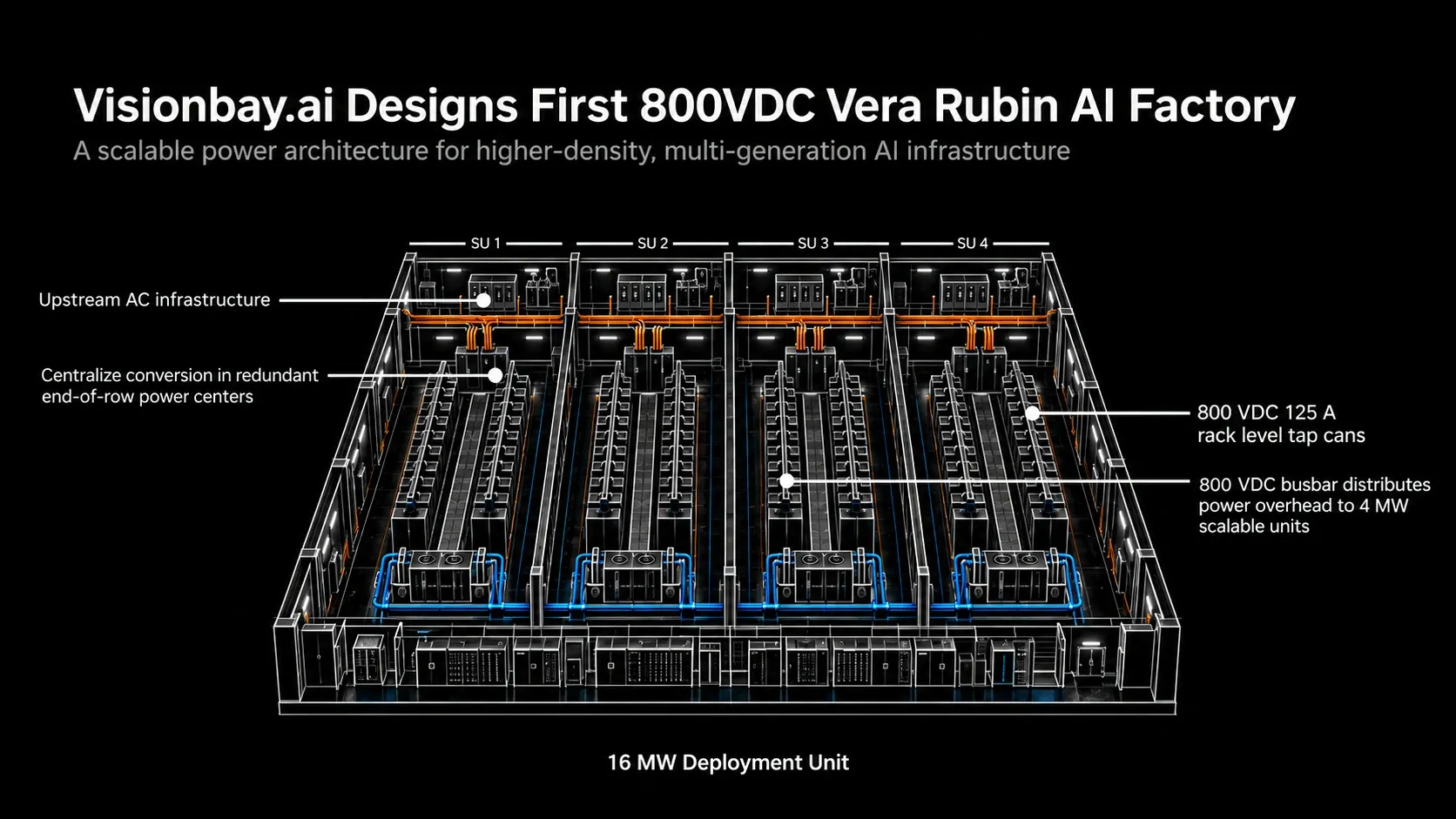

NVIDIA 2Visionbay.ai’s proposed power layout for a Vera Rubin AI factory uses 800-volt DC distribution to supply high-density computing infrastructure. (Image source: NVIDIA)

The rack contribution sits alongside a separate effort to align the buildings that house AI systems. An Open Data Center specification hosted by OCP lists AMD, Google, Meta and NVIDIA as contributors. It addresses facility layout, structural requirements, power distribution and cooling, giving operators guidance that extends beyond a particular server cabinet.

Revision 0.7.0 of the specification took effect on August 27, 2026, and covers infrastructure for AI and machine-learning systems targeting 2027–2028 and beyond. It provides guidance for future data center development.

The specification aims to let colocation providers and other suppliers develop and manufacture equipment for a shared facility design. It also describes sourcing components from multiple vendors and using established manufacturing processes. This offers an industry rationale for standardization: suppliers can work toward common requirements rather than repeatedly engineering infrastructure for individual customers.

Its scope is broader than NVIDIA’s rack contribution. The participation of AMD, Google and Meta reflects an attempt to accommodate multiple generations of AI systems. Open facility guidance can support common infrastructure without requiring every operator to use the same processors or purchase identical computing equipment.

Electrical behavior is another part of the coordination effort. A separate OCP grid-interface specification, developed through collaboration among Google, Microsoft, NVIDIA and Meta, addresses how large data centers should respond to disturbances on the utility grid. Its objective is to maintain grid stability while accommodating the changing power demands of computing installations.

The document describes large AI and machine-learning facilities whose consumption can exceed hundreds of megawatts. It sets out a framework for disturbance performance at the point where a facility connects to the grid, including voltage ride-through and the recovery of active power after a fault.

Shared requirements could reduce repeated engineering work between operators, equipment suppliers and utilities. The specification presents that as an intended benefit, alongside more consistent design and deployment.

The initiatives address different pieces of the same construction task: manufacturing computing equipment, preparing facilities and coordinating electrical operation. NVIDIA’s rack contribution supplies one part of that framework.