@2026 Finance News International. All Rights Reserved.

Blends Media
A Blends Media Group Production

AWS Launches Open-Source Physical AI Toolchain with NVIDIA Software

Arry Hashemi
Arry Hashemi
Oct. 12, 2026
AWSAWS’s Physical AI Toolchain combines cloud infrastructure with NVIDIA software to help developers train, test and deploy robots. (Image source: Amazon)

Amazon Web Services has introduced an open-source Physical AI Toolchain that combines its cloud infrastructure with NVIDIA’s robotics software, bringing model development, virtual testing and deployment into a common framework. The launch article describes a collection of reference architectures, code and deployment automation that developers can adapt to their own robots and tasks.

The release addresses work that happens between individual development tools: transferring training data, allocating computing resources, tracking model versions and preparing software for physical machines. AWS says the framework supports different robot designs rather than supplying a finished robot or a ready-made set of behaviors. Developers still bring the hardware, task definitions and data needed for their applications.

Uwem Ukpong, vice president of AWS Industries, said: “Physical AI is going to touch every industry that moves, builds, or makes things, and our customers are moving fast to capture that opportunity. We built the Physical AI Toolchain on AWS because customers told us that too much of their engineering effort was going to infrastructure instead of innovation. We want to flip that.”

The toolchain covers synthetic data generation, model training, simulation and validation, edge deployment, and continuous improvement. Those stages connect the preparation of a model with its eventual operation on a machine.

Amit Goel, head of Robotics Developer Ecosystem and Edge AI Product at NVIDIA, said: “Building physical AI requires a seamless integration of three computing platforms—training, simulation, and deployment. The open-source Physical AI Toolchain on AWS brings together AWS services with NVIDIA’s physical AI models, tools, and libraries to provide a scalable, end-to-end workflow that helps developers accelerate the creation, training, validation, and deployment of intelligent robotics applications.”

Simulation supplies a way to examine robot behavior before committing hardware to a task. NVIDIA’s Isaac Sim documentation describes software that builds virtual environments from sources including engineering designs, robot descriptions and real-world captures. Developers can configure physical properties and sensors, then test how a robot responds inside those environments.

Training data can also be expanded within a simulator. Lighting, colors, object positions and other scene properties can be varied to produce additional examples. Isaac Sim supports both software-in-the-loop and hardware-in-the-loop evaluation, allowing testing to involve software alone or incorporate actual equipment. Its connection with Isaac Lab supports robot learning within the simulated environment.

AWS 2Amazon draws on its experience operating more than 1 million robots to inform its Physical AI Toolchain on AWS. (Image source: Amazon)

NVIDIA’s Cosmos platform provides another part of that process through models that generate data for physical AI development. NVIDIA explains that simulated scenes can become inputs for generating additional visual training material. Simulation and generated data therefore serve related purposes: one provides an environment for testing behavior, while the other broadens the material available to train models. Neither capability, by itself, establishes how reliably a finished robot will perform.

The AWS framework separates cloud development from the computing needed on a robot. Its technical announcement identifies latency, power consumption and thermal limits as constraints on physical movement. Cloud infrastructure coordinates training and fleet management, while time-sensitive decisions must be handled on the machine for safety-relevant tasks.

AWS’s robotics architecture guidance describes AWS IoT Greengrass performing two functions at the edge: running machine-learning inference for robot control and collecting sensor information for subsequent improvement. This creates a route for operational observations to return to development, where teams can revise models and examine situations encountered outside the training environment.

Businesses can adopt individual components or manage the broader development cycle through a single control plane. The company also describes fleet-management capabilities for provisioning, securing and updating thousands of machines over the air. That flexibility allows an organization to introduce a particular training or testing component without immediately replacing its entire development workflow.

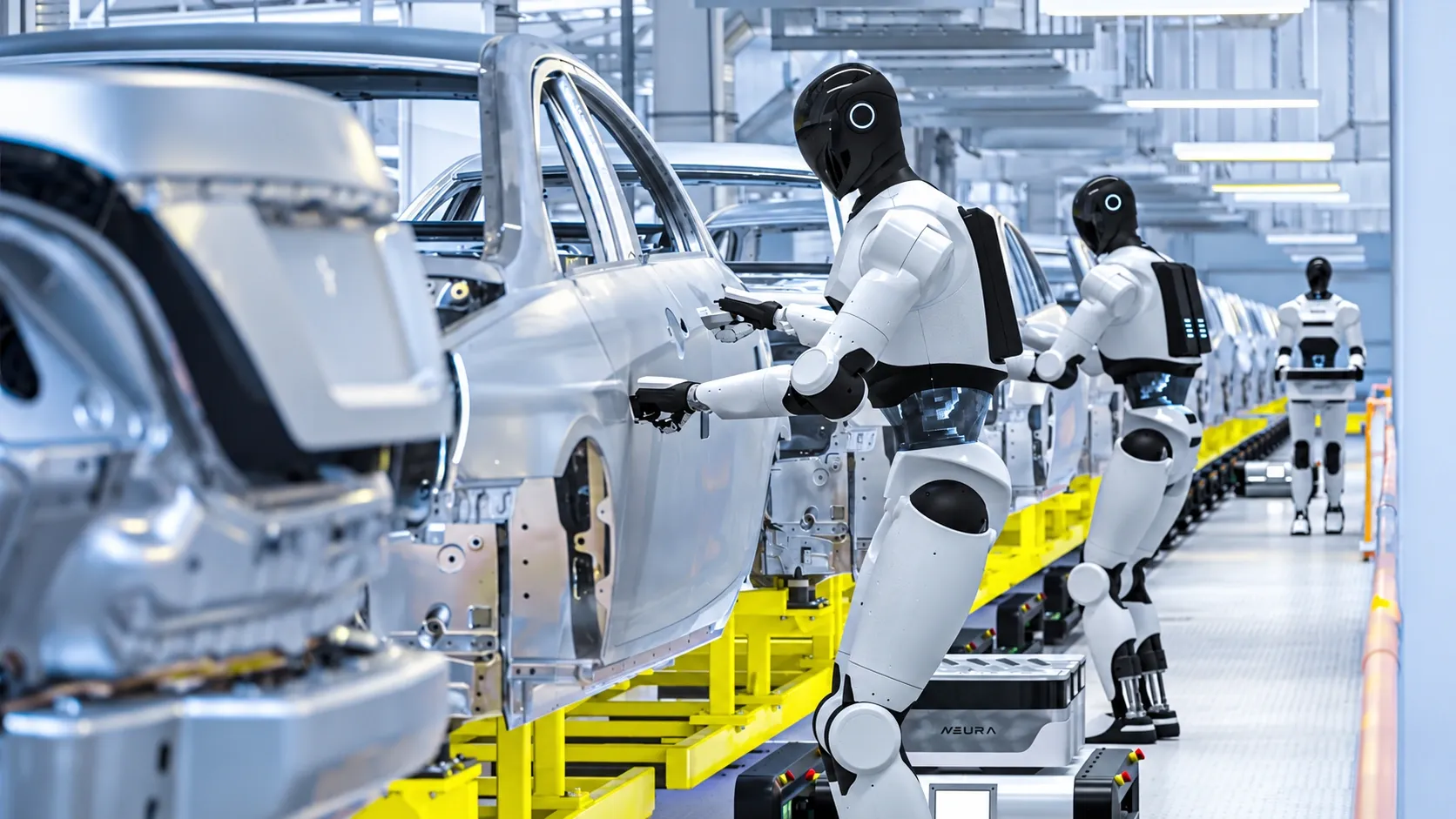
Amazon names NEURA Robotics, RLWRLD and Config in its announcement, illustrating different approaches to building physical AI systems. NEURA is developing cognitive humanoid robots.

David Reger, founder and CEO of NEURA Robotics, said: “In Physical AI, speed is everything: how fast you can fine-tune models, deploy them into the real world and scale from individual systems to large fleets. The Physical AI Toolchain on AWS helps us accelerate exactly that cycle. By combining NEURA’s Physical AI stack with AWS’s experience in large-scale infrastructure and deployment, we can move much faster from learning to real-world deployment and ultimately scale Physical AI globally.”

RLWRLD is building an 8.1-billion-parameter foundation model for dexterous manipulation. The work concerns robotic hands handling objects across industrial and service settings. Config, meanwhile, has assembled a pipeline capturing more than 200,000 hours of robot action data and uses generative AI to expand the training scenarios drawn from that material.

Amazon’s own operations provide additional background. A separate robotics announcement reported the deployment of its millionth robot at a fulfillment center in Japan, within a network spanning more than 300 facilities. That operational experience is relevant to managing machines at scale.

The framework’s open-source description does not remove the costs of running cloud workloads. AWS’s robotics guidance states that deploying its sample resources may generate charges for services such as Amazon EC2 and Amazon S3. Computing and storage therefore remain part of the implementation budget, alongside the physical equipment needed to collect data and operate robots.

Production readiness also remains the user’s responsibility. The same guidance assigns customers the work of testing, securing and optimizing sample content for their own quality standards. Its architecture demonstrates a development approach; adopting it does not eliminate the validation needed before a robot enters an operational environment.