@2026 Finance News International. All Rights Reserved.

Blends Media
A Blends Media Group Production

Visa and NymCard Unveil Nym4Business B2B Payments Platform Across CEMEA

Arry Hashemi
Arry Hashemi
Oct. 08, 2026
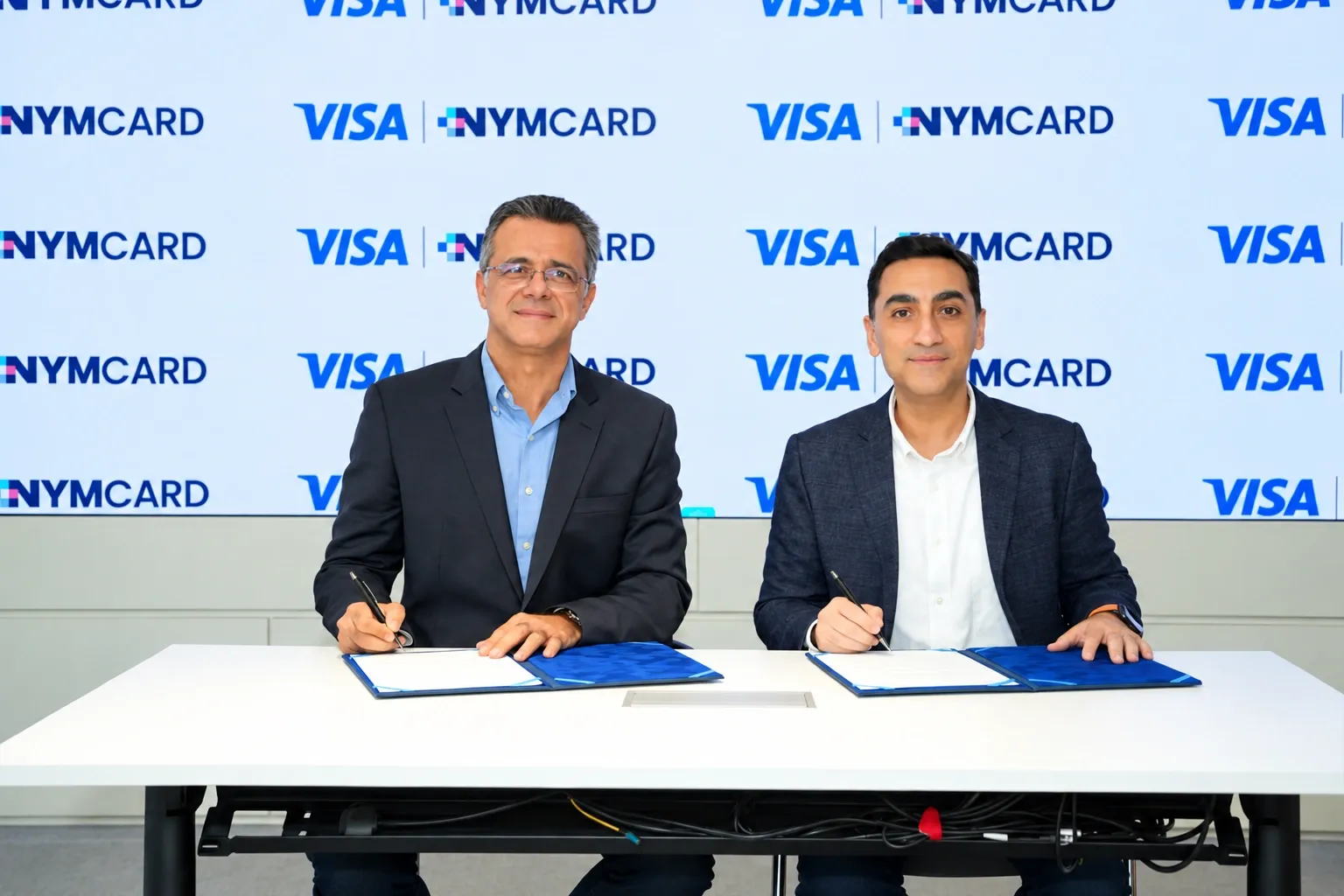
NymCard and VisaVisa and NymCard’s Nym4Business platform brings commercial cards, expense management and supplier payouts together for financial institutions serving businesses across CEMEA. (Image source: NymCard)

Dubai-based embedded finance provider NymCard has teamed up with Visa to introduce Nym4Business, a dedicated commercial payments platform aimed at banks and non-bank financial institutions across Central and Eastern Europe, the Middle East, and Africa.

The initiative is available exclusively to Visa clients and focuses on helping those institutions deliver digital business-to-business services to small and medium-sized enterprises as well as larger corporates.

The partnership combines NymCard’s regional payments infrastructure with Visa’s data APIs and commercial payment products. It arrives as many businesses in the CEMEA region still rely on fragmented tools for spending, invoicing, and supplier payments. NymCard describes the platform as already in use among some MENA financial institutions, with further rollout planned in other CEMEA markets.

NymCard, founded in 2018 and licensed by the Central Bank of the UAE, operates as a principal member of both Visa and Mastercard. Its core platform supports card issuing, money movement, and related services for banks, fintechs, and enterprises across multiple markets in the region. The new collaboration extends that capability specifically into commercial offerings tailored for business customers.

Visa executives framed the move as a response to demand from SMEs for more integrated payment tools. Many smaller companies currently juggle multiple providers for cards, expense tracking, and payouts. The joint platform seeks to reduce that complexity by packaging several functions under one infrastructure layer that financial institutions can brand and configure.

Early adoption has concentrated in the Middle East and North Africa. Expansion efforts are now underway in additional CEMEA markets, though specific timelines or partner names beyond the general description were not detailed in the announcement.

VisaVisa is extending its collaboration with NymCard to support digital business payments across Central and Eastern Europe, the Middle East, and Africa. (Shutterstock)

Financial institutions using Nym4Business can issue commercial cards equipped with advanced spend controls. These tools allow limits by category, merchant, or other parameters, giving businesses tighter oversight of employee or departmental expenditures. The same infrastructure supports expense and invoice workflow management, helping finance teams track and approve spending digitally rather than through manual processes.

Real-time supplier and merchant payouts form another key component. Institutions can facilitate quicker transfers to vendors, reducing delays common in traditional B2B payment chains. Domestic and cross-border money movement options are integrated as well, enabling institutions to offer clients a broader range of transfer capabilities without stitching together separate systems.

Onboarding is designed to be configurable so that banks, telcos, acquirers, and other participants can adapt the platform to their existing compliance and product requirements. The companies position this flexibility as a way for institutions to launch modern commercial programs more quickly than building equivalent capabilities from scratch.

Omar Onsi, chief executive of NymCard, said: “This is a defining moment for commercial payments in our region. Together with Visa, we’re innovating how banks and financial institutions could better serve their business customers. Drawing on feedback from the thousands of SMEs we already serve, we built the Nym4Business platform to give them the tools to digitize, launch, and scale SME payment programs with speed, control, and complete flexibility.”

Fadi Moukaddem, senior vice president and group country manager for the UAE, Kuwait, and Qatar at Visa, added: “Partnerships like this demonstrate the power of combining global capabilities with regional innovation. By bringing together Visa’s network, expertise and commercial payment solutions with NymCard’s embedded finance platform, we are helping accelerate the development of more modern and scalable financial services for businesses across the region. We look forward to working together to support the next generation of commercial payment experiences and contribute to a more digitally enabled business ecosystem.”

Shahebaz Khan, senior vice president and head of commercial and money movement solutions for CEMEA at Visa, stated: “Today, SMEs increasingly seek integrated, one-stop-shop solutions that simplify how they make and receive payments. Yet, many continue to navigate a fragmented landscape of dealing with several financial service providers to meet their basic needs. Through our partnership with NymCard, we address this fragmentation by enabling a seamless, end-to-end financial experience to provide the best way to pay and be paid.”

NymCard has expanded steadily since its founding, raising capital in successive rounds that include a $33 million Series B tranche in March 2025 led by QED Investors, with participation from existing backers. Total funding reported across rounds sits in the range of roughly $66 million to $70 million. The company lists operations or live markets spanning several countries in MENA and maintains offices in locations that include Dubai, Riyadh, Cairo, and others.

Earlier collaborations with Visa have covered areas such as stablecoin settlement in the GCC and integrations involving Visa Direct for cross-border transfers. The Nym4Business launch builds on that relationship by focusing specifically on commercial and SME-oriented tools rather than consumer or settlement infrastructure alone.

The platform’s design reflects ongoing efforts across CEMEA markets to move business payments away from paper-based or highly manual processes toward more automated digital rails.