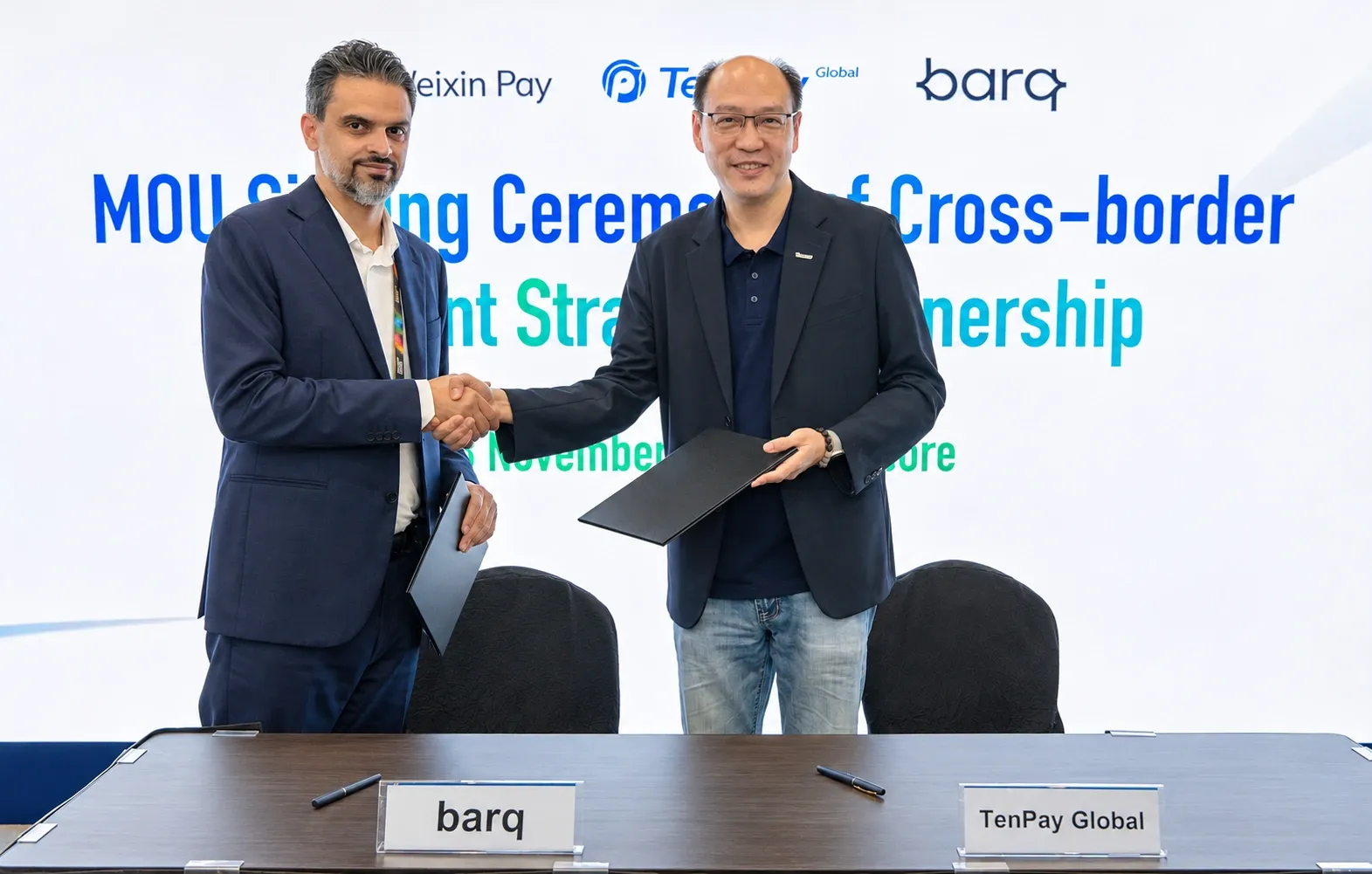
Singapore — Tencent's cross-border payment platform TenPay Global has signed a memorandum of understanding (MOU) with Saudi wallet barq, which holds a Saudi Central Bank (SAMA) license, so that barq customers can send money to Weixin wallets in the Chinese mainland and pay by QR code at Weixin Pay merchants there.
Wenhui Yang, who runs TenPay Global's Singapore entity, and barq founder Ahmed Alenazi put their names to the agreement at the Singapore FinTech Festival 2026, TenPay Global said in an announcement.
An MOU records what two companies intend to do together rather than a finished product. TenPay Global described the barq wallet's acceptance at Chinese merchants as something that follows the completion of a technical integration, and neither company gave a date for either service to go live.
The remittance side of the deal opens the way for barq to connect to TenPay Global's cross-border remittance platform. According to TenPay Global, that platform counts more than 60 major international banks and remittance firms among its partners and handles transfers to China from over 150 countries and regions. Transfers into Weixin run 24/7, and the company said funds can land in under a minute.
The network was smaller three years ago. When Visa extended Visa Direct to Weixin users in 2023, TenPay Global had over 30 remittance partners spread across more than 60 countries and territories. Tencent and Visa signed a further MOU on October 29 this year that covers travel payments and more transfers into the Weixin Pay ecosystem.
The second strand concerns travel. barq customers visiting the Chinese mainland would be able to scan and pay at the tens of millions of merchants that take Weixin Pay, using the wallet they already hold at home.
After the integration, barq would sit alongside the more than 60 foreign wallets, drawn from 16 countries and regions, that mainland Weixin Pay merchants already take. Others on that list include PayPal from the US, Samsung Wallet and Travel Wallet from South Korea, MoMo and ZaloPay from Vietnam, and ShopeePay in Southeast Asia.
Use of those wallets is rising. Between January and October 2026, Weixin Pay handled 84% more transactions from overseas digital wallets in China than a year earlier, according to TenPay Global.
Singapore's DBS joined the same wallet scheme a week earlier. On November 12, TenPay Global said more than three million users of DBS PayLah! could pay at Weixin Pay merchants in the Chinese mainland, either by scanning a merchant's QR code or by showing their own. Before confirming, PayLah! users see the amount in yuan, the exchange rate and the Singapore dollar equivalent.
On the Saudi end, the target market is large. Citing SAMA figures, TenPay Global said expatriates in Saudi Arabia sent approximately $33.7 billion out of the country between January and September 2026, and it called the kingdom one of the world's largest remittance markets.
Riyadh-based barq was founded in 2023 and says it serves more than 15 million users of over 210 nationalities. In September 2026 it became a unicorn after raising $329.5 million (SAR 1.24 billion) in a Series A round that valued the company at $1.85 billion (SAR 6.94 billion), with Noon Investments, Sohar International Bank and M20 Fund among the investors.
Wenhui Yang, CEO of TenPay Global (Singapore), said: “Cross-border payments work best when they are built into the services people already use every day. That is why we work with strong local partners rather than asking users to change how they pay, connecting their wallets to the Weixin ecosystem in an open and interoperable way. We see strong long-term potential in the Middle East, and this partnership is an important step in bringing the region and China closer together through payments.”
Ahmed Alenazi, Founder and CEO of barq, added: “This partnership marks a strategic step in our international expansion and reflects our commitment to building meaningful partnerships with leading global financial and technology companies to develop digital financial solutions that transcend geographical boundaries. Through our collaboration with TenPay Global, we look forward to strengthening financial connectivity between Saudi Arabia and China and providing our users with a faster, more convenient experience in remittances and digital payments.”
If the integration goes ahead, the deal could give barq's users, drawn from more than 210 nationalities, a direct route into Weixin wallets, and it would add a Saudi wallet to a merchant network whose named partners are so far in the US and Asia. How soon customers see either service will depend on integration work for which no timetable has been published.
barq already has cross-border links. It offers international transfers through a partnership with Western Union, added Alipay+ services in 2026, and runs its regulated activities through Buraq Financial Company, which SAMA licenses and supervises. When it closed its Series A, barq said the money would help it enter regional and international markets, without naming its first destinations.