@2026 Finance News International. All Rights Reserved.

Blends Media
A Blends Media Group Production

UAE Crypto Economy Grows 32% to $104.8 Billion in 2025–2026

Arry Hashemi
Arry Hashemi
Oct. 29, 2026
UAEChainalysis estimates the UAE received $104.8 billion in crypto value in the year to June 2026, up from $79.5 billion a year earlier. (Pixabay)

The value of crypto flowing into the United Arab Emirates rose 32% to $104.8 billion in the year to June 2026, blockchain analytics firm Chainalysis said in its latest regional study, leaving the country close behind Türkiye as the largest crypto market in the Middle East and North Africa.

The estimate covers value received between July 2025 and June 2026, which Chainalysis labels the 2026 period. At that size the UAE stands at 73% of Türkiye's $144.5 billion, and the firm said the Emirates is on pace to overtake Türkiye as early as the 2027 period.

The UAE grew while the region as a whole stood still. MENA's crypto economy dipped 1.4% to $443.3 billion from $449.6 billion, in line with the worldwide trend, and Chainalysis calculated that the rest of the region would have shrunk 8.6% without the UAE. Together, Türkiye and the UAE hold 56% of the regional total, so their opposite moves largely canceled each other out, while 16 of the 24 MENA markets with measurable data grew.

Most of the UAE's expansion came from crypto services such as exchanges. That segment reached $102.3 billion, up 29% on the prior period. Inflows to centralized exchanges climbed 22% to $55 billion, while decentralized finance exchanges took in more than $31 billion, an increase of 31%.

Institutional platforms, a category that covers custodians and market makers, posted the sharpest gain within services: their inflows rose 75% to $11.7 billion. According to Chainalysis, that is four times the global growth rate for the same category, and the UAE's lead over the rest of the region widened in 2026 across every category the firm measures.
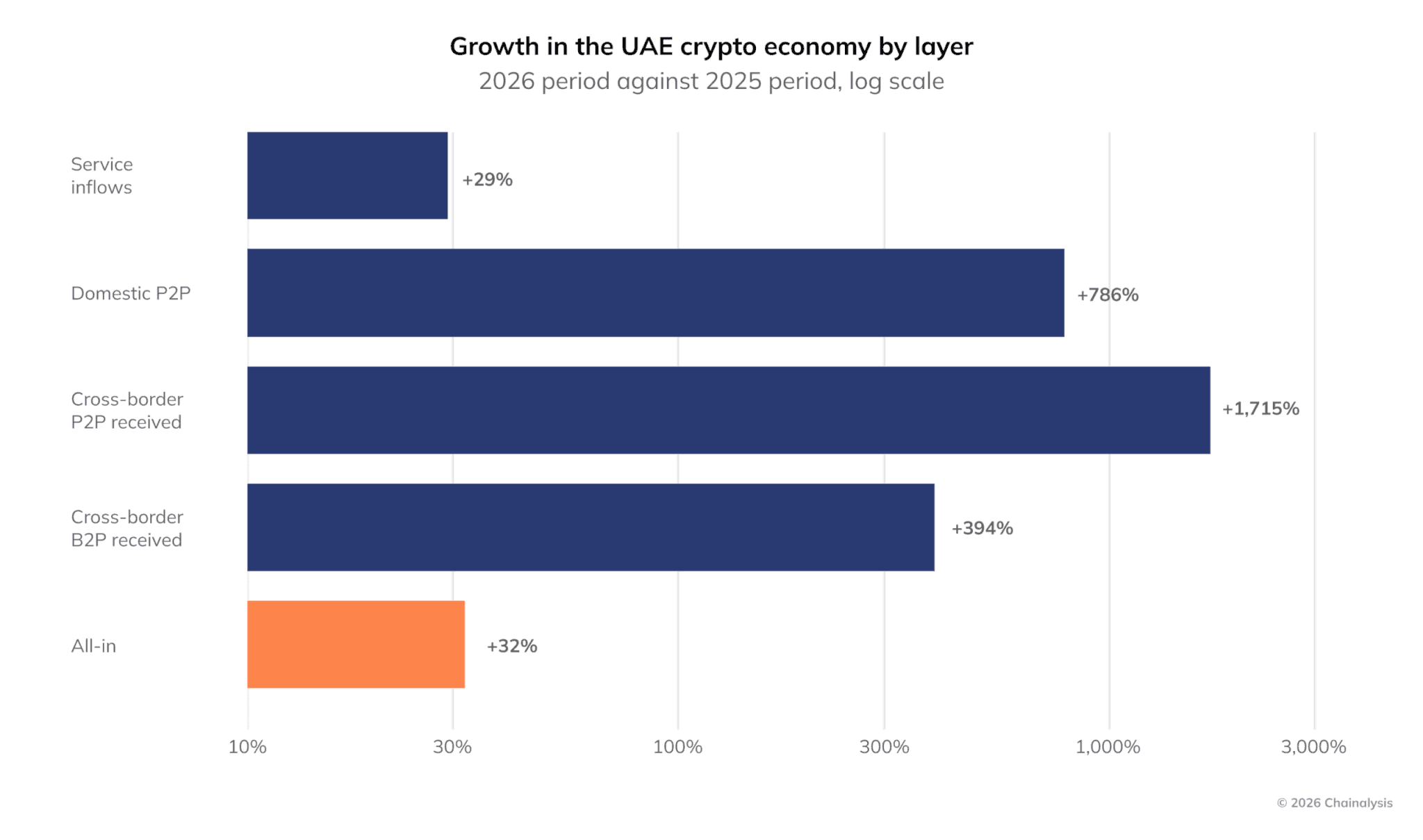
Chart comparing growth in UAE crypto service inflows, peer-to-peer and business paymentsPeer-to-peer and business-to-person flows grew far faster than service inflows in the UAE, though services still made up most of its crypto economy. (Image source: Chainalysis)

Peer-to-peer and cross-border payment flows in the UAE remain far smaller than the services side, but they grew at a much faster rate. Domestic peer-to-peer payments jumped 786%, cross-border peer-to-peer inflows rose 18-fold and cross-border business payments increased by nearly 400%, helped by a surge in stablecoin transfers of $1 million or more.

Chainalysis linked the UAE's performance to years of courting crypto businesses as part of a broader effort to diversify an economy that has historically relied on oil. The report said that by leading on crypto regulation, the UAE could gain influence over an emerging part of global financial markets.

That framework is split across several licensing authorities, including Dubai's Virtual Assets Regulatory Authority (VARA), the Financial Services Regulatory Authority (FSRA) at Abu Dhabi Global Market and the Dubai Financial Services Authority (DFSA). VARA alone has licensed more than 50 firms, among them nearly all of the 20 largest global crypto companies, according to the report.

Henri Arslanian, co-founder of Nine Blocks Capital Management, which Chainalysis describes as the first crypto hedge fund licensed by VARA, said: “Outside of the U.S., MENA and in particular the UAE has become the main hub for crypto firms’ global operations,” and credited the readiness of UAE financial regulators to issue licenses as a driver of adoption.

That readiness, Arslanian said, “reduced in large part the career risk for any corporate executive in dealing with digital assets.”

The type of client has also changed, according to people working in the market. Laurent Girouille, Senior Executive Officer at Rain Trading Limited, said: “A year ago, the growth conversation here was about retail access,” adding: “Today the questions we get are operational: who is the regulated counterparty, where are the assets held, how does settlement reconcile. Those come from treasuries, family offices and licensed intermediaries rather than from first-time buyers.”

Stablecoin payments between companies are a large part of that business. Arslanian said: “Many globally underestimate how much stablecoins are being used in B2B transactions” in the UAE, adding: “The UAE has become a global hub for such transactions.” He attributed this to the country's many regulated over-the-counter (OTC) brokers, which he said give businesses a reliable way to convert crypto back into conventional currency.

UAE 2Stablecoins are finding wider use in the UAE for business payments and cross-border transfers, according to Chainalysis. (Shutterstock)

A spokesperson for Fuze Finance said: “Stablecoins are increasingly being viewed as financial infrastructure rather than simply an asset used within crypto markets,” adding: “We are seeing more interest in using them for cross-border settlement, corporate treasury, merchant payments and remittances.”

Chainalysis also tracked a shift in what UAE investors hold. In March 2026, the number of bitcoin holders and tokenized gold holders in the country both climbed. The two trends then split: the share of tokenized gold holders kept rising, and the number of bitcoin holders began to shrink, although bitcoin remains far more popular than tokenized gold in the UAE.

Türkiye still leads the region, though its crypto economy contracted modestly. Right at the end of the study period, it began enforcing rules that require every crypto asset service provider to hold a license from the financial regulator SPK. Activity moved from licensed platforms to wallet-to-wallet transfers, and Turkish domestic peer-to-peer volume grew fivefold to $3.56 billion, nearly three times the rest of MENA combined, with nearly all of the growth in stablecoins.

Burcu Küçükünal, CEO of Turkish exchange Stablex, said: “Crypto in Türkiye is becoming part of traditional finance rather than a parallel system,” and said the law “raised the operational bar for the whole industry,” a regime under which crypto firms must follow the same compliance protocols as financial institutions.

The regional figures sit within a difficult year for crypto prices. In its global adoption index, Chainalysis found that total crypto market capitalization fell about 50% over the same period, while worldwide on-chain activity slipped just 1.6% to $9.4 trillion from $9.5 trillion. The firm describes its estimates as a lower bound, saying the real crypto economy in every market is larger than it reports.

This year's report also introduced a new methodology, which weighs service flows, domestic peer-to-peer transactions, cross-border flows and on-chain balances. On that basis the UAE's 2025 period stood at $79.5 billion. Chainalysis' previous edition had put the UAE at an estimated $53 billion with 33% growth for the year to June 2025, so the two sets of figures are not directly comparable.

Other rankings have pointed the same way. In September, the UAE rose to second place in Henley's 2026 Crypto Adoption Index with a score of 46.4 out of 60, behind Singapore's 47.1. The faster growth of institutional platforms and large stablecoin transfers could make the UAE's market less dependent on retail trading than some of its neighbors, though that rests on Chainalysis' own estimates.