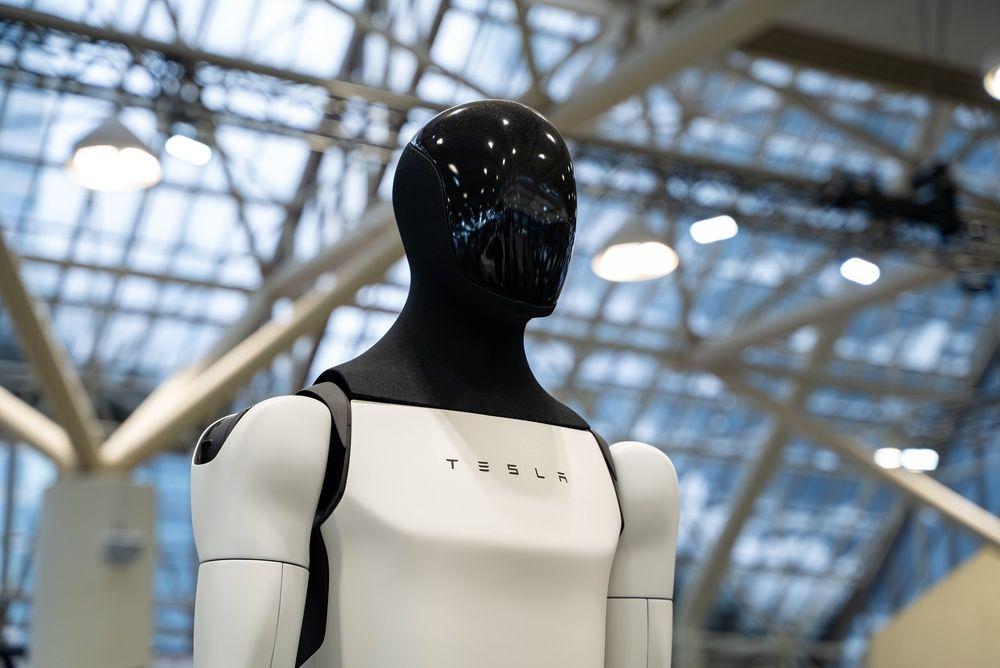
Musk described the ramp as an S-curve whose early stretch is flat and bumpy because Optimus is such a new kind of product. Around 10,000 separate things have to go right to build the robot, he said, and output moves only as fast as the slowest and least lucky of them, partly because some of the design is still changing. Mass-producing complex new hardware also means assembling a huge global supply chain and running a very large factory in the U.S., with every piece working.
Musk said: “And there’s still some things we need to tweak about the design because you need to deliver a robot that is safe and reliable and has long duration. So it can’t wear out after a month. And there’s still quite a lot of work to do with regard to the AI in the robot. For it to be truly useful for open-ended tasks.”
He expects the AI, the electromechanical design and the robot’s working life to be sorted out around the end of next year, and said that is when Tesla should begin delivering Optimus to companies outside Tesla. Later in the call, he said he would be “stunned if anyone has a robot that is remotely competitive with Optimus” once deliveries start, “which is likely to be towards the end of next year.” Musk also said: “But to the best of my knowledge, there is no one that is even close to Tesla with respect to a general-purpose humanoid robot.”
The hand is still the hardest part. When Deutsche Bank analyst Edison Yu asked where the remaining design changes sit, Musk passed the question to Konstantinos Laskaris, who said most of the robot’s electromechanical system has converged on a design that works well enough. The hand is more complex than the actuators that drive the robot’s locomotion, Laskaris said, and Tesla is still developing some custom gears that carry much of the load for power consumption and reliability.
Musk said: “And the fingers especially, just, it’s a hard problem, ’cause humans have self-repair, like our hands repair, our body repairs itself, but robots don’t, so you have to, and our fingers are kind of squishy and have lots of sensors in our skin. It’s hard to make a hand that can handle lots of wear and tear, but is still, squishy enough to pick up delicate objects and has all the sensors and doesn’t damage the sensors when you do repeated actions.” Building the hand had shown how remarkable the human version is, he said, adding that other parts of the robot are improving too.
Training data is the other constraint. Crowdsourcing is not the issue, Musk said, but the AI architecture still needs work and the robot needs far more data than Tesla can gather today. Musk said: “And really, in order for Optimus to get the training data we need, we actually need to make a lot of Optimi. So we need to make, I think, on the order of 10,000 or 20,000 bots and then have them do self-play. And we’re building out an Optimus Academy where Optimus can practice doing a very wide range of tasks. And then we can use that data in sort of a flywheel to make it better and better at these various tasks.”
Tesla has no existing robot fleet to learn from, unlike its cars, so it must bootstrap Optimus by building machines and letting them practice, Musk said, comparing the process to the way a toddler learns through play. Ashok Elluswamy said there is no exoskeleton people could wear to steer the robot like a puppet, so Optimus first learns by watching humans and then practices in simulation and in the real world. He said that large reinforcement learning loop is close to producing very good results.
Fitting Tesla’s AI5 chip into Optimus is the next hardware milestone. Musk expects that around April next year if things go to plan, bringing an order of magnitude more compute than the AI4 chip. Musk said: “And that will help Optimus a lot because the degrees of freedom that a humanoid robot has to deal with are far greater than what a car has to deal with.” He estimated a humanoid robot may do 1,000 times more things than a car, or some other very large multiple.
A public showing may come sooner. Musk said Tesla could release an Optimus video in a month or two, and wants it to show the robot doing tasks that are not pre-programmed. Many humanoid demonstrations look impressive but rely on fixed, deterministic routines and would not work well in the real world, he said.
Factories are likely to be the first customers. Musk said: “Things that are like dangerous repetitive tasks, things that people really don’t want to do. So, and that you want done basically 24/7. So like around-the-clock stuff. That’s gonna be the highest value for Optimus in the beginning.” Home robots would follow as output grows, he said, but the most valuable early uses are heavy industry, dangerous jobs and work that can cause repetitive stress injuries.
Tesla is not waiting for a final hand design. Musk said it is already building robots without perfected hands, refining the supply chain, production system, engineering and AI software in parallel, adding that “we’re going as fast as humanly possible here.” Chief financial officer Vaibhav Taneja said Tesla has also started constructing a factory in Austin that will be able to make many more robots than Fremont. Optimus costs are trending toward where CyberCab costs are expected to end up, he said, though it is too early to say the target has been reached while the design keeps changing.
The push is visible in the accounts. Operating expenses rose 39% from a year earlier to $4.78 billion in the quarter, and Taneja said pre-production ramp costs for new products such as Optimus were among the drivers, along with additional compute and chip development. Musk called the planned TeraFab chip plant an important asset for scaling Optimus because it could ease semiconductor bottlenecks. Tesla and SpaceX are developing a Terafab chip project in Texas with more than $16.8 billion in planned first-phase investment.
Other carmakers are moving into the field. Toyota has been pitching investors a plan to deploy 400,000 robots under a $6.4 billion annual factory automation program. If Tesla keeps to its timetable, that could raise the stakes for rivals, though Optimus revenue still depends on the hand redesign, the AI5 chip arriving around April and outside deliveries starting near the end of next year.