
@2026 Finance News International. All Rights Reserved.

Blends Media
A Blends Media Group Production

China's Economic Growth Accelerates to 4.5% as Exports Drive Growth

Arry Hashemi
Arry Hashemi
Oct. 19, 2026
China portChina's economy grew 4.5% in the third quarter of 2026, supported by exports and industrial production despite sluggish domestic demand. (Shutterstock)

BEIJING, China — China's economy expanded 4.5% in the third quarter of 2026, accelerating from the previous quarter as stronger exports and industrial production helped offset persistent weakness in consumer spending, property investment, and broader domestic demand.

The National Bureau of Statistics (NBS) reported on October 19 that gross domestic product grew 4.5% year over year between July and September, compared with 4.3% in the second quarter and 5.0% in the first. On a seasonally adjusted basis, the economy expanded 1.2% from the preceding quarter.

Economic growth averaged 4.6% during the first nine months of the year, placing China within its official annual growth target range of 4.5% to 5.0%. However, the latest figures revealed significant differences between the performance of export-oriented industries and sectors that depend more heavily on spending and investment at home.

The figures offer a mixed assessment of the world's second-largest economy. While manufacturing and international trade have provided substantial support, declining property investment and subdued retail sales continue to complicate efforts to establish a more balanced pattern of growth.

Industrial activity remained one of China's strongest economic performers during the first three quarters. According to the NBS report, value added by major industrial enterprises increased 5.3% year over year, with manufacturing output rising 5.7%.

Higher-technology industries recorded considerably faster expansion. High-tech manufacturing grew 14.3% during the nine-month period, while equipment manufacturing increased 10.2%. Production of industrial robots rose 29.1%, reflecting continued investment in advanced manufacturing capabilities.

September figures also showed renewed momentum. Industrial production increased 5.5% from a year earlier, accelerating by 0.3 percentage points from August. The official manufacturing purchasing managers' index stood at 50.1, marginally above the 50-point threshold separating expansion from contraction.
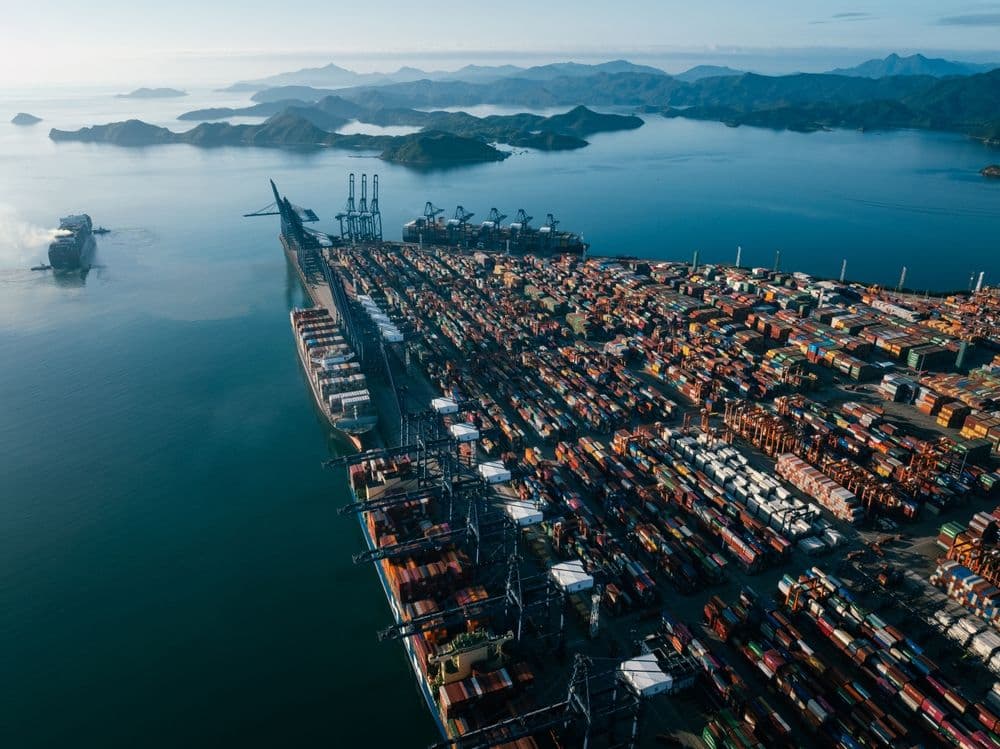

China port 2Cargo ships and shipping containers illustrate the scale of global trade. China's goods exports rose 16.4% in the first nine months of 2026. (Shutterstock)

International trade provided another source of strength. The total value of China's goods imports and exports increased 18.8% year over year during the first nine months, with exports rising 16.4% and imports growing 22.3%, according to the NBS.

The combination of stronger factory output and trade activity indicates that external demand continues to play an important role in supporting economic growth. However, reliance on manufacturing and overseas markets leaves the economy exposed to changes in global demand, trade restrictions, and competition in major export industries.

Domestic consumption presented a less encouraging picture. Retail sales of consumer goods increased just 1.1% during the first nine months of 2026, considerably slower than the growth recorded in industrial production.

September retail sales also rose 1.1% year over year, although the result represented an improvement of 0.7 percentage points from August. The modest acceleration suggests some stabilization in household spending without establishing a sustained recovery in consumer demand.

Different areas of consumption performed unevenly. Retail sales of services increased 5.0% during the first three quarters, while sales of goods grew only 1.0%. Online retail sales of goods and services rose 4.4%, reflecting continued growth in digital commerce despite the weakness in broader spending.

Household income data provided a somewhat stronger reading. Nationwide per capita disposable income increased 5.3% in nominal terms during the first nine months, equivalent to real growth of 4.4% after adjusting for inflation.

The gap between income growth and retail spending illustrates the challenge facing policymakers. Improving household earnings does not necessarily translate immediately into stronger consumption, particularly when consumers remain cautious about employment prospects, housing values, and their financial security.

ChinaGlobal trade remains an important part of China's economic outlook, with the country's manufacturing sector expanding 5.7% in the first nine months of 2026. (Unsplash)

China's property sector remained a major source of economic weakness. Investment in real estate development declined 20.6% year over year during the first nine months.

The contraction extended beyond residential construction. Overall fixed-asset investment, excluding rural households, fell 7.2%, while private investment declined 10.4%. Infrastructure investment dropped 4.2%, and manufacturing investment decreased 2.1%.

Property transactions also remained under pressure. The floor space of newly built commercial buildings sold declined 13.2%, while the value of those sales fell 13.9% during the January-to-September period.

These figures indicate that the difficulties facing the property industry continue to affect construction activity and investment decisions. The sector's prolonged weakness also creates challenges for businesses and local economies that depend on property development and related spending.

Investment in selected technology-related industries offered a contrasting trend. High-tech industry investment increased 4.9%, including a 20.2% rise in information services investment. Nevertheless, growth in these areas has not been sufficient to reverse the broader decline in fixed-asset investment.

Consumer prices increased 0.9% during the first nine months, according to the NBS. September inflation was also 0.9% year over year, while core inflation, which excludes food and energy, reached 1.0% for the month.

Producer prices moved more sharply. Prices for industrial products increased 2.3% over the nine-month period, with September producer prices rising 5.0% year over year. The difference between consumer and producer inflation suggests that pricing conditions vary considerably across the economy.

China 2China's urban unemployment rate stood at 5.2% in September 2026, highlighting the importance of job market stability as the country navigates an uneven economic recovery. (Unsplash)

Employment indicators showed relative stability. The nationwide urban surveyed unemployment rate averaged 5.2% during the first three quarters, matching the corresponding period of 2025. September's unemployment rate was also 5.2%, down 0.1 percentage points from August.

Although the headline employment figures remained steady, weak consumer spending and falling private investment suggest that confidence in the domestic economy remains an important issue.

The NBS acknowledged the difficulties in its October 19 assessment, identifying insufficient domestic demand and uncertainty in the international environment as continuing challenges to stable economic growth.

The third-quarter acceleration provides some support for China's efforts to meet its annual growth objective. GDP growth of 4.6% across the first nine months leaves the economy within the government's targeted range, although the final outcome will depend on performance during the last quarter.

The underlying data suggest that China's immediate economic challenge is not a shortage of industrial production. Manufacturing, advanced technology, and international trade have continued to expand, while domestic investment and household consumption have struggled to keep pace.

This imbalance creates competing priorities for economic policymakers. Supporting household demand and stabilizing the property sector could help broaden the recovery, while maintaining industrial competitiveness remains important to employment, investment, and export performance.

The latest figures also highlight why stronger headline GDP growth does not necessarily indicate that economic pressures have eased across every sector. Exporters and technology manufacturers may benefit from expanding activity even as property developers, retailers, and other domestically focused businesses face difficult conditions.