@2026 Finance News International. All Rights Reserved.

Blends Media
A Blends Media Group Production

XPENG Unveils IRON Humanoid Robot, Targets Public Release in Q2 2027

Arry Hashemi
Arry Hashemi
Nov. 27, 2026
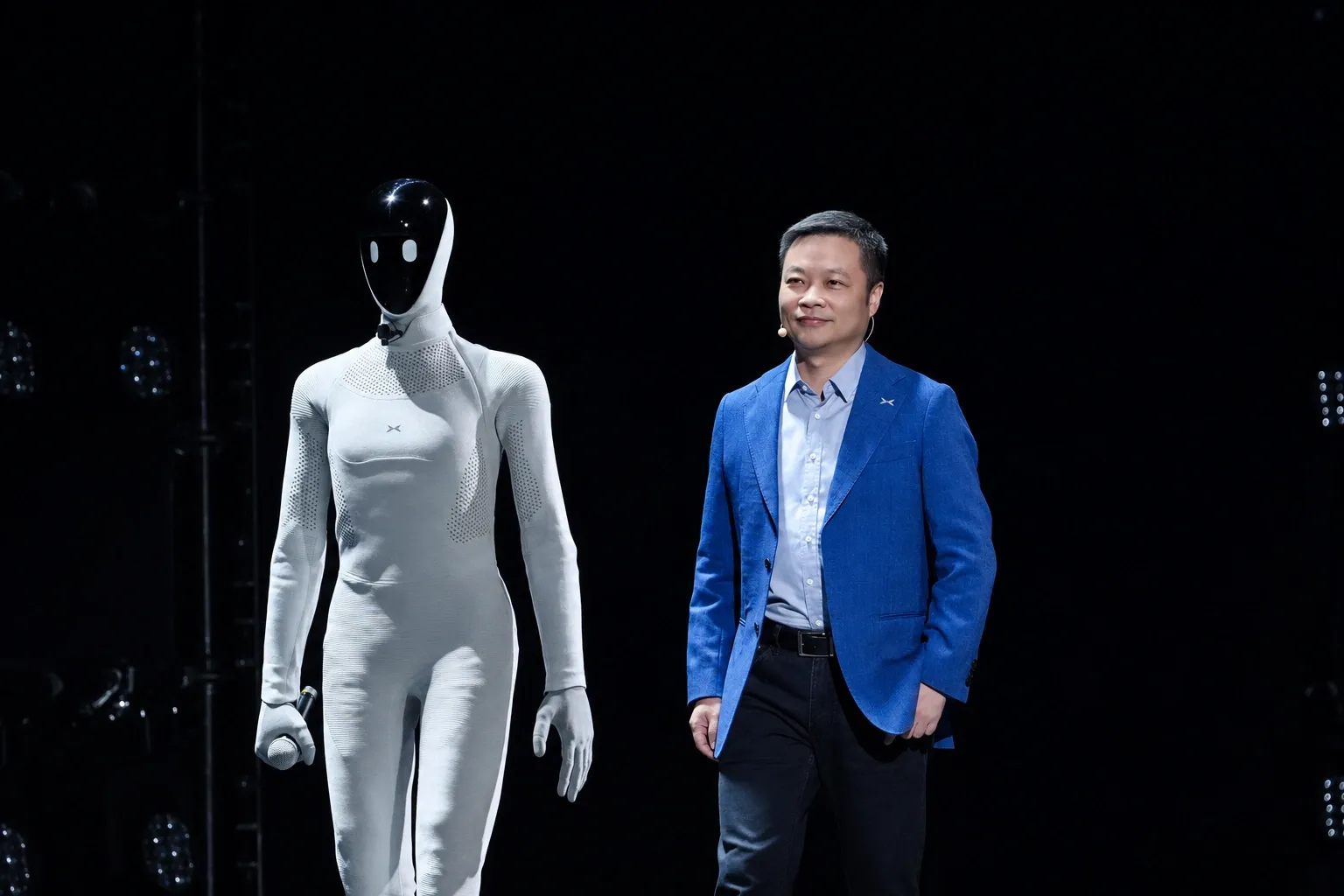
XPENG chairman He Xiaopeng on stage beside the white IRON humanoid robotHe Xiaopeng, Chairman and CEO of XPENG, walks on stage beside the IRON humanoid robot, which will begin training as a store assistant in 2027. (Image source: XPENG)

Guangzhou, China — Chinese electric vehicle maker XPENG has presented IRON, its advanced general-purpose humanoid robot, in what it called the machine's first public debut, and plans to start training it as a store assistant in its own retail outlets in the first quarter of 2027.

An official public release of the robot is targeted for the second quarter of that year. IRON shared the stage at XPENG's eighth AI Day, held under the theme ORIGIN, with the Turing Physical AI Architecture (VLA 3.0), a framework the company says ties AI cognition, split-second decision-making and physical execution together across its cars and humanoid robots.

XPENG, which calls itself a Physical AI company and is listed in New York (NYSE: XPEV) and Hong Kong (HKEX: 9868), said in its announcement that it expects the next advance in the field to come from improving intelligence and physical ability at the same time. Rather than betting on standalone AI models or single components, it is developing the entire stack in-house, covering its own chips and models, perception, software, control systems and the hardware itself. The new architecture is meant to be one technical base for its vehicles and robots, and to support its moves into self-driving mobility and flying cars.

He Xiaopeng, Chairman and CEO of XPENG, said: “For years, the AI industry has focused on making the brain smarter. But humans do not learn through the brain alone. We learn by touching, moving, trying, failing and trying again. I believe Physical AI must evolve in the same way. Origin is about returning to that fundamental truth. The brain and body must evolve together. By connecting intelligence all the way through to physical action, we want to build AI that does not simply understand our world, but can work alongside us and grow through real-world experience.”

The architecture is built from three layers that run at different speeds. At the bottom, System 0, which XPENG calls the ultra-fast system, brings control of the physical body into the AI's closed loop. It coordinates the hardware behind power, energy, communication and execution, so the AI gets direct feedback on the body's condition and on whether it can act safely and effectively. The fast layer, System 1, runs on XPENG's VLA 2.0 model; it reads the surroundings and quickly turns that reading into actions the machine can carry out.

The slow layer, System 2, handles higher-level reasoning. It pairs task planning based on vision and language with a state machine called Agent Runtime, which works out goals, plan complicated jobs and coordinate the steps needed to finish them. According to XPENG, the layers combine action skills with multimodal understanding and connect AI models to computing, control and hardware in one continuous loop, with data on the body's state and the outcome of each action fed back so the system keeps adapting and improving.

The company also said version 6.4.0 of its VLA 2.0 model supports closed-loop training run autonomously by Agents, which it said makes training 10–12 times faster overall. The same process allows model self-distillation and recursive self-improvement (RSI), which XPENG said speeds up model development and helps models adapt to different computing platforms. Cars and robots use common data infrastructure, computing, safety and control technology, while each develops specialized skills for its own hardware and tasks. XPENG said its automotive research, testing and manufacturing experience feeds into robotics, and that what it learns about robotic sensing and interaction may shape future vehicle experiences.

On the road, XPENG wants AI to coordinate the whole car, not just the driving. The X-VMC 2.0 motion control system for its vehicles ties together steering, braking, propulsion, suspension and other parts, letting AI influence how the car drives, its safety, cabin comfort and how it manages energy. The company also introduced Turing AI Co-driving, whose first feature, VLA Adaptive Deceleration, reads the road scene to adjust how the car slows and recovers energy once the driver lifts off the accelerator. In XPENG's tests in congested city traffic, usable range rose 12.4% against driving with energy recovery turned off. The first over-the-air (OTA) rollout is scheduled for December 2026.

XPENG also showed a technology still under development called AEX 360-degree active avoidance, which coordinates the car's movement when a collision risk appears, and said vehicle accident claims in China have fallen 13.93% since its VLA 2.0 model rolled out. Its NGP intelligent driving system, also powered by VLA 2.0, is being validated across several markets and driving conditions. Having tested and localized the system in France, Germany and the Netherlands, the company began offering members of the public urban NGP rides from its Paris store in November. XPENG says no Chinese carmaker had previously offered public high-level assisted-driving trips from a retail site in Europe, and it aims to start rolling NGP out globally during the first half of 2027.
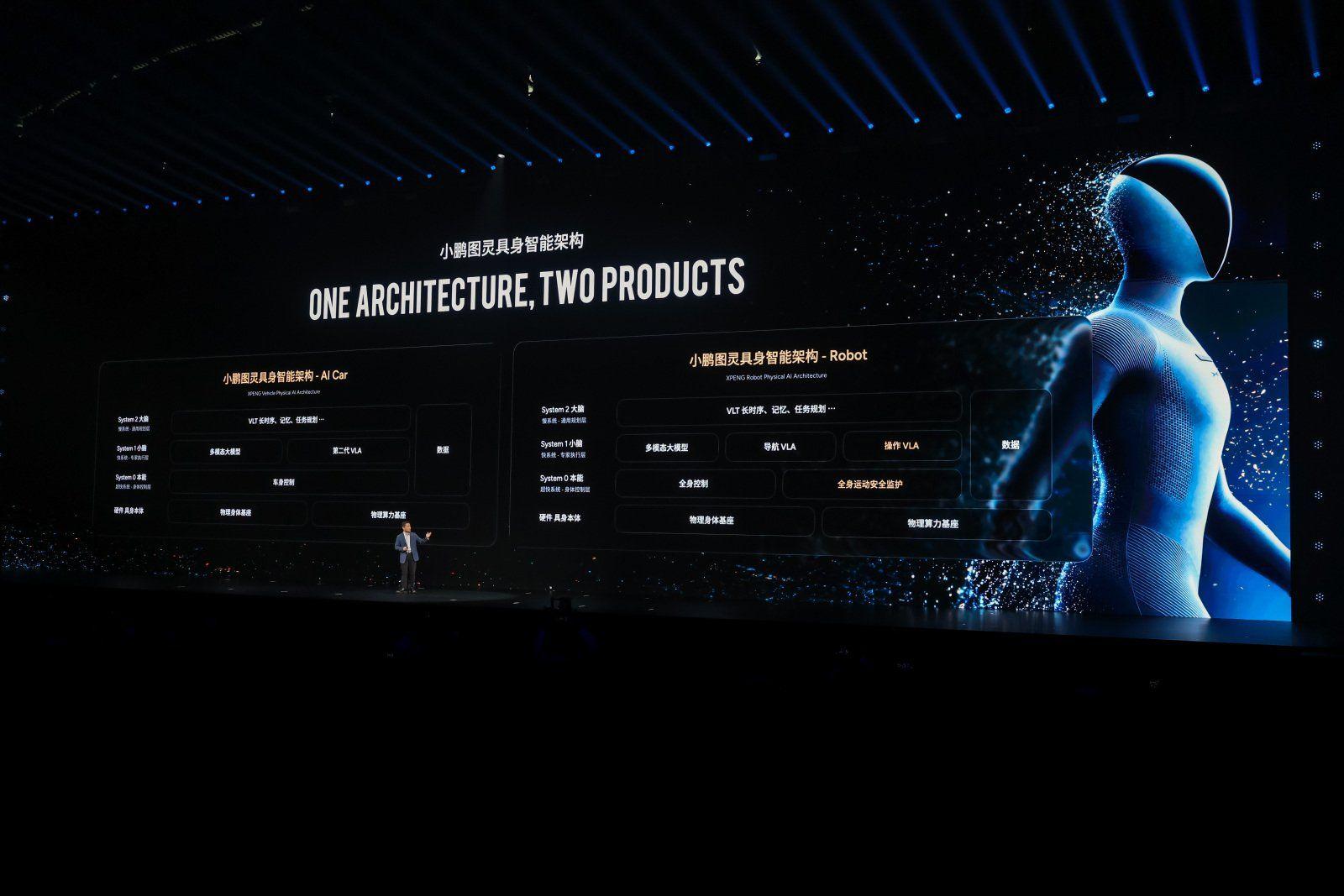

Stage screen titled One Architecture, Two Products comparing XPENG's car and robot AI systemsA slide at XPENG AI Day sets out how the Turing Physical AI Architecture is shared between the company's cars and its humanoid robot. (Image source: XPENG)

IRON is being built the same way, with its hardware, motion control, perception, computing and AI models developed in tandem. The robot has 76 degrees of freedom, its body carries over 1,500 tactile sensing points, and touch sensing covers more than 80% of its key body areas. Three of XPENG's own Turing AI chips handle whole-body control and the AI models on board, while its architecture links navigation, manipulation, task planning and multimodal understanding to physical execution and safety monitoring.

XPENG is pitching the robot as a partner for real-world work. The robot can find its way around on its own, accept tasks by voice or through an app, recharge itself, report abnormal conditions and track its own operating health. To prepare it for deployment, the company has set up a Robot Data Factory covering 15 job categories and more than 250 scenarios, which reuses evaluation and data-processing tools from its car business. A dedicated automated assembly line carries out over 1,000 tests on finished robots and key components and checks more than 600 AI holographic quality-inspection items.

Partners will be able to download capability packages, tailor functions, and build and test new skills for particular business applications through an open robotics ecosystem the company is building. XPENG plans to earn money from hardware sales, software subscriptions and the open platform, and it said token-based subscriptions and scenario-based services are also being explored.

The new schedule follows the commissioning of XPENG's humanoid robot production lines in Guangzhou in September 2026, when the company said more than 80% of core processes were automated. At the time, it said its robots were due to reach mass production before the end of 2026, with the first commercial rollouts in its own stores and campuses, and that it planned to launch and deliver them officially in China and abroad in 2027.

A store-assistant phase ahead of a public release could give XPENG time to test IRON with real customers before wider sales, and its mix of hardware, subscriptions and an open platform may matter as much as the robot itself if partners build skills for it. The timeline also lands as Tesla moves its own humanoid toward volume: the U.S. carmaker has said it began building Optimus on high-volume production lines at its plant in Fremont, California.

XPENG's Robotaxi program took eight months to move from road tests with safety staff on board to driverless testing, and it obtained an L4 demonstration operation qualification in Guangzhou only 11 months after the company announced the business. Driverless L4 tests with passengers have begun, and XPENG plans demonstration operations in selected areas before the end of 2026. It sees itself as a supplier of technology and solutions, providing vehicle platforms and autonomous driving capability to operating partners. YOYO-01, the first Robotaxi model it has designed specifically for commercial service, is due out in 2027, and XPENG aims to take the service to international markets with those partners.

Its flying-car unit, XPENG ARIDGE, is moving its manned electric vertical take-off and landing (eVTOL) program toward airworthiness certification. It has finished certification flight testing and received Type Inspection Authorization documentation. In the United Arab Emirates, the unit and local partners are setting up a low-altitude regulatory sandbox that will host testing and help it explore international cooperation. At a Dubai brand event on November 2, 2026, XPENG said ARIDGE and the emirate of Ras Al Khaimah are developing a sandbox for personal flying cars, overseen by the General Civil Aviation Authority (GCAA), and that a demonstration route between Abu Dhabi and Ras Al Khaimah is planned.

Dr. Brian Gu, Vice Chairman and President, XPENG, said at the Dubai event: “The Middle East combines an appetite for embracing new technology with some of the world’s most ambitious plans for how people will live and move in the future. That makes it an important market for XPENG. We are starting by bringing vehicles and technologies designed around the realities of the region, from long distances to extreme heat. But our ambition goes much further. As we deepen our presence here, we want to bring more of XPENG’s Physical AI capabilities to the Middle East, spanning intelligent vehicles, robotaxis, humanoid robots and flying cars.”

Guests at that event saw IRON in person, and XPENG said initial overseas deliveries of the robot are targeted for the first half of 2027.