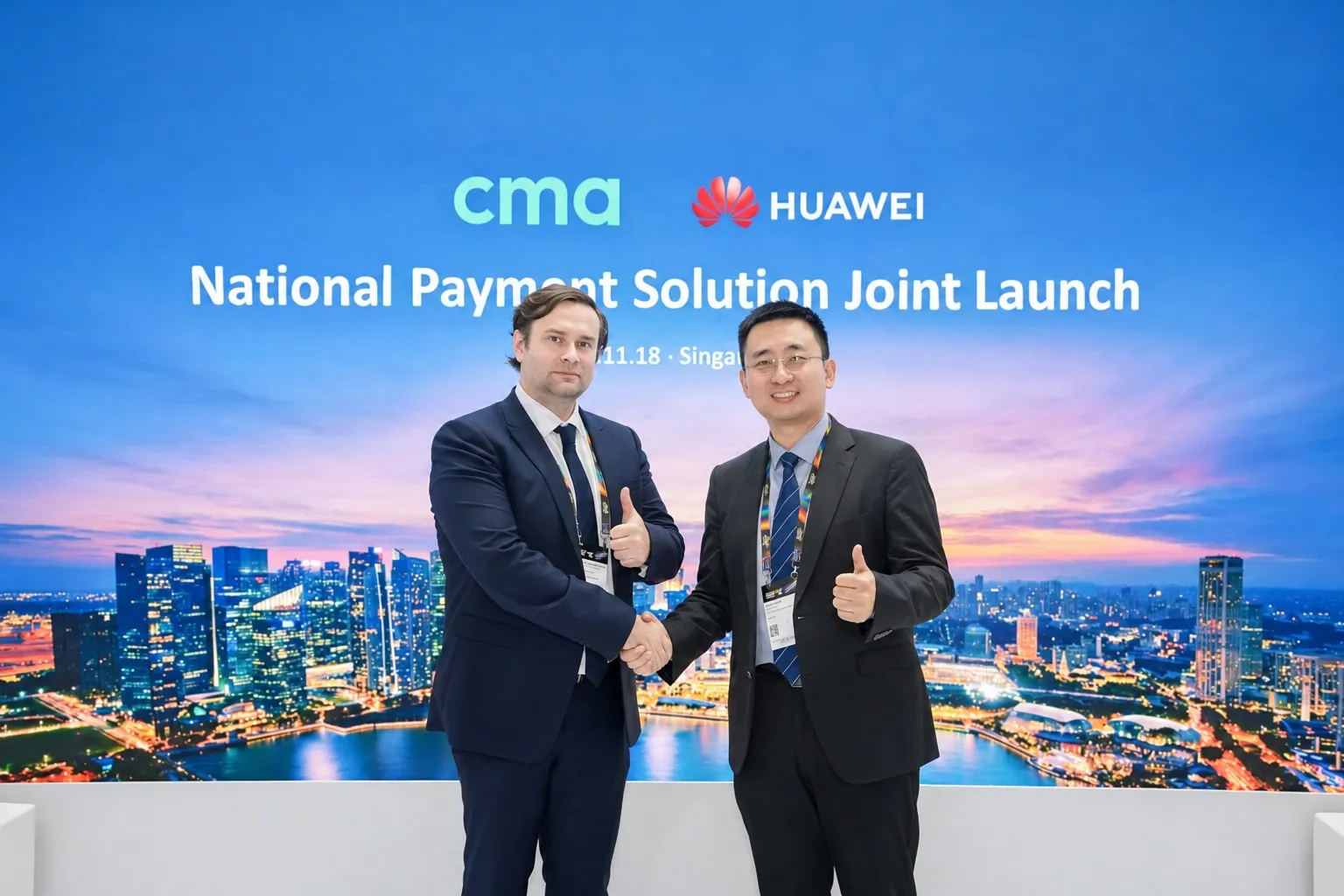
Singapore — Chinese technology group Huawei and Swedish payments software developer CMA Small Systems AB have introduced a joint National Payment Solution for central banks and financial institutions, bundling CMA's settlement software with Huawei's computing, storage, networking, cloud and data center infrastructure.
The product was unveiled at the Singapore FinTech Festival 2026 (SFF 2026), which Singapore's central bank organizes with the Global Finance & Technology Network (GFTN) and which lists more than 70,000 participants from 142 countries and regions. Frank LU, Director of Central Bank Integrated BU Solution Sales Dept., Huawei, and Maxim Neshcheret, Regional Director, Asia, CMA Small Systems AB, represented the two companies at the launch ceremony.
Their stated aim is to give central banks and financial institutions one end-to-end package for modernizing national payment systems, according to the joint announcement issued by Huawei. CMA belongs to the Huawei Global Financial Partner RONGHAI Program, the network Huawei uses to work with software firms serving the financial sector.
The offer rests on a division of labor. CMA, which has spent more than 30 years in financial market infrastructure, supplies the payment applications, while Huawei provides the hardware and cloud layer they run on. A customer would buy the payment software and the infrastructure beneath it as a single integrated system instead of assembling the two separately.
CMA's clients include central banks, commercial banks, clearing houses and securities depositories. Its core products cover real-time gross settlement (RTGS) systems, which settle large interbank payments individually as they occur, automated clearing house (ACH) systems that process routine payments in bulk, instant payment systems (IPS) for round-the-clock transfers, and securities depository systems.
The companies said the solution can run in high-availability and disaster recovery setups, so that critical payment systems keep operating and business continuity is protected. Central banks can also roll it out in stages and add capacity as their business needs change.
Through the RONGHAI program, Huawei and CMA have put in place a shared process for developing solutions, delivering projects and supporting customers. According to the companies, that arrangement should reduce the complexity of system integration and project governance, and allow them to adapt the package to customers in different countries and regions.
Huawei placed the launch in the context of a broader shift in finance. Payment systems are moving toward real-time processing, higher efficiency and better interoperability as digital transformation reshapes the industry, the release said, and that is raising expectations for system performance, security, business continuity and the resilience of the underlying infrastructure.
The product is the latest step in a partnership that has deepened over the past year. CMA was named among three new members of the RONGHAI partner network at SFF 2025, alongside Instadesk and MagicEngine. Huawei started the program in 2024 to work more closely with financial industry partners and speed up its customers' digital and intelligent transformation.
Huawei and CMA put their plans on paper in September 2026, when a memorandum of understanding signed at HUAWEI CONNECT 2026 in Shanghai set out how they would cooperate on technology integration, joint solution development, market expansion and customer services. Huawei's account of that agreement said CMA had completed more than 500 projects worldwide and that its core systems run at more than 60 central banks.
Huawei now describes the relationship as moving on from ecosystem collaboration to building solutions and going to market together, calling the launch another important milestone for the partnership.
Gulf central banks have been building national payment systems of the kind the two companies are targeting. In the UAE, Al Etihad Payments, a subsidiary of the Central Bank of the UAE, launched the Aani instant payments platform in October 2023, and Aani has since passed 12.5 million users, with 74 licensed financial institutions connected, among them 85% of the banks operating in the country.
The UAE also takes part in regional systems such as the GCC's AFAQ and the Arab Regional Payment System, Buna, and its central bank is exploring a connection between its instant payment system and Morocco's. The Committee on Payments and Market Infrastructures, hosted by the Bank for International Settlements, said in a 2024 report that governance and oversight are central challenges when fast payment systems are linked across jurisdictions and currencies.
A bundled software-and-hardware package could appeal to central banks that prefer one coordinated supplier pairing to managing separate vendors, although the release names no customers, contract values or deployment timelines. Huawei said it will keep working with CMA on joint innovation and market collaboration in national payment systems, taking their joint solutions to more markets worldwide.