@2026 Finance News International. All Rights Reserved.

Blends Media
A Blends Media Group Production

Apple Overtakes Nvidia as World’s Most Valuable Company at $5.03 Trillion

Arry Hashemi
Arry Hashemi
Nov. 02, 2026
AppleApple reclaimed the top spot among the world’s most valuable companies, with a $5.03 trillion market capitalization placing it ahead of Nvidia. (Shutterstock)

Apple held an $88 billion lead over Nvidia in the global market capitalization ranking checked on November 2, after a steeper decline in the chipmaker’s shares put the iPhone maker back in first place at the end of October.

CompaniesMarketCap listed Apple at $5.029 trillion and Nvidia at $4.941 trillion. Apple’s share price stood at $344.63, compared with $204.64 for Nvidia. The displayed daily declines were 1.23% and 4.22%, respectively.

The reversal came during Friday’s October 30 trading session. Both companies lost ground, but Nvidia’s larger percentage fall changed their order. Apple’s return to the top therefore came on a down day for its own shareholders, rather than through a fresh rally.

The gap between the companies amounted to about 1.8% of Nvidia’s listed market value. Their combined capitalization was $9.970 trillion, leaving the pair close to the $10 trillion mark even after the declines.
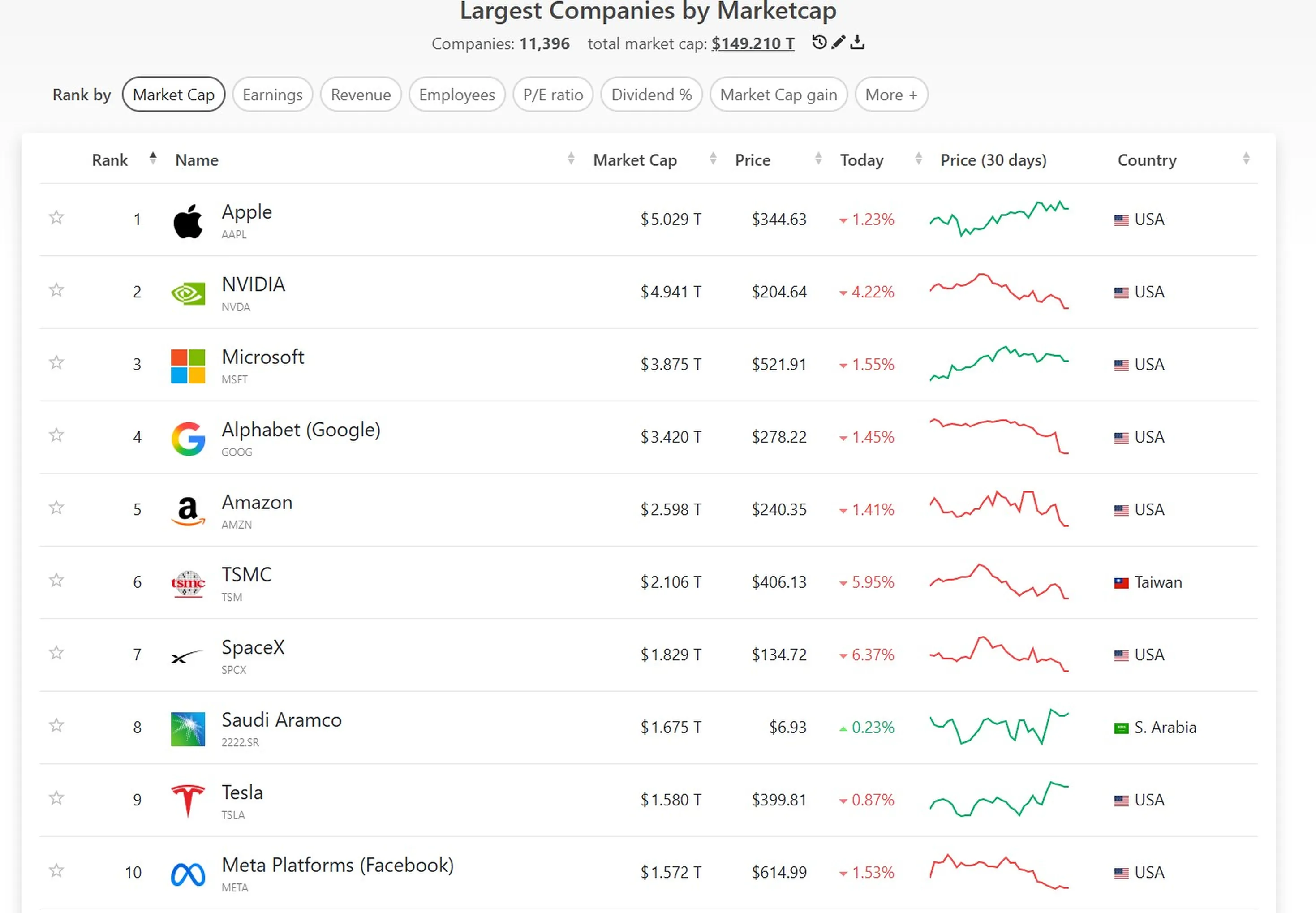
CompaniesMarketCapApple and Nvidia’s combined market value approached $10 trillion in this CompaniesMarketCap ranking, with Microsoft, Alphabet and Amazon rounding out the top five. (Image source: CompaniesMarketCap)

At those valuations, a 1% move in either company’s shares would add or erase roughly $50 billion in market value, assuming its share count remained unchanged. That is more than half the gap between them, illustrating how a relatively small price movement could put the lead back in contention.

Apple’s lead was considerably smaller than its distance from Microsoft, which ranked third at $3.875 trillion. Alphabet followed at $3.420 trillion and Amazon at $2.598 trillion. Those positions placed five U.S. technology businesses at the top of the website’s global ranking when it was checked.

The change in leadership brings two different exposures to the AI economy into view. Nvidia sells computing infrastructure used to develop and operate AI systems. Apple’s investment case also rests on consumer devices, software and services. Friday’s ranking shows how those businesses were priced against each other at one market close; it does not establish which strategy will deliver stronger returns over time.

Nvidia’s most recent published quarterly results provide a counterpoint to the share-price decline. In its August 26 earnings release, the company reported revenue of $96.2 billion for the second quarter of fiscal 2027, up 106% from a year earlier and 18% from the preceding quarter.

AppleApple’s hold on the top spot will depend on future share-price movements and changes in outstanding shares. (Shutterstock)

Data center revenue reached $89.0 billion, an increase of 117% from a year earlier. The business accounted for roughly 93% of total quarterly revenue. That concentration helps explain why expectations for spending on computing infrastructure are relevant to Nvidia’s outlook.

The company projected third-quarter revenue of $108 billion, plus or minus 2%, and said that forecast assumed no data center compute revenue from China. Those were management’s expectations when the August results were released, rather than completed third-quarter results. Strong reported growth can coexist with falling shares when investors reassess the earnings and risks already reflected in a stock’s price.

An $88 billion difference in capitalization consequently does not mean Apple earned that much more than Nvidia, or received an equivalent cash inflow. Share prices can change throughout trading, while changes in outstanding share counts can also affect the calculation. The ranking compares equity valuations, rather than the operating scale of the two businesses.

Apple’s November 2 check puts it ahead of Nvidia on CompaniesMarketCap’s figures, with less than two percentage points separating their valuations. Subsequent price moves or updated share counts could change that margin and the order again.