@2026 Finance News International. All Rights Reserved.

Blends Media
A Blends Media Group Production

Anthropic Strikes Reported $35 Billion Cloud Deal With Nvidia-Backed Lambda

Arry Hashemi
Arry Hashemi
Sep. 03, 2026
Dario AmodeiAnthropic co-founder and CEO Dario Amodei. The Claude developer has reportedly agreed to a $35 billion cloud-computing deal with Nvidia-backed Lambda as it expands its AI capacity. (Image source: Anthropic)

Anthropic has agreed to spend $35 billion on computing capacity from Lambda, according to a report by Bloomberg. The agreement places the artificial intelligence developer at the center of another major infrastructure commitment as competition for advanced chips and data center power intensifies.

The agreement involves a Texas data center being developed by Hut 8 and is intended to bring additional Nvidia-powered capacity online for Anthropic’s Claude artificial intelligence models.

Texas Campus Provides the Infrastructure

Hut 8 has publicly disclosed agreements covering the underlying data-center campus, although its announcements did not name Anthropic, Lambda or Nvidia as the customer. In a July 20 press release, the company said it had signed a second 15-year lease for 352 megawatts of information technology capacity at its Beacon Point campus. The transaction doubled the unidentified tenant’s contracted capacity there to 704 megawatts.

The two Beacon Point leases carry a combined base-term contract value of $19.6 billion. Renewal options could raise the campus-level value to as much as $50.2 billion, although those options are not guaranteed to be exercised. Hut 8 described the customer only as a “high-investment-grade tenant” and said all of its contracted AI data-center capacity was either leased to or supported by investment-grade counterparties.

An earlier Hut 8 announcement dated May 6 disclosed the first 352-megawatt lease at Beacon Point. That release said the initial phase would be designed using Nvidia’s DSX reference architecture for large-scale AI infrastructure. It valued the first lease at $9.8 billion over its 15-year base term but again withheld the customer’s identity.
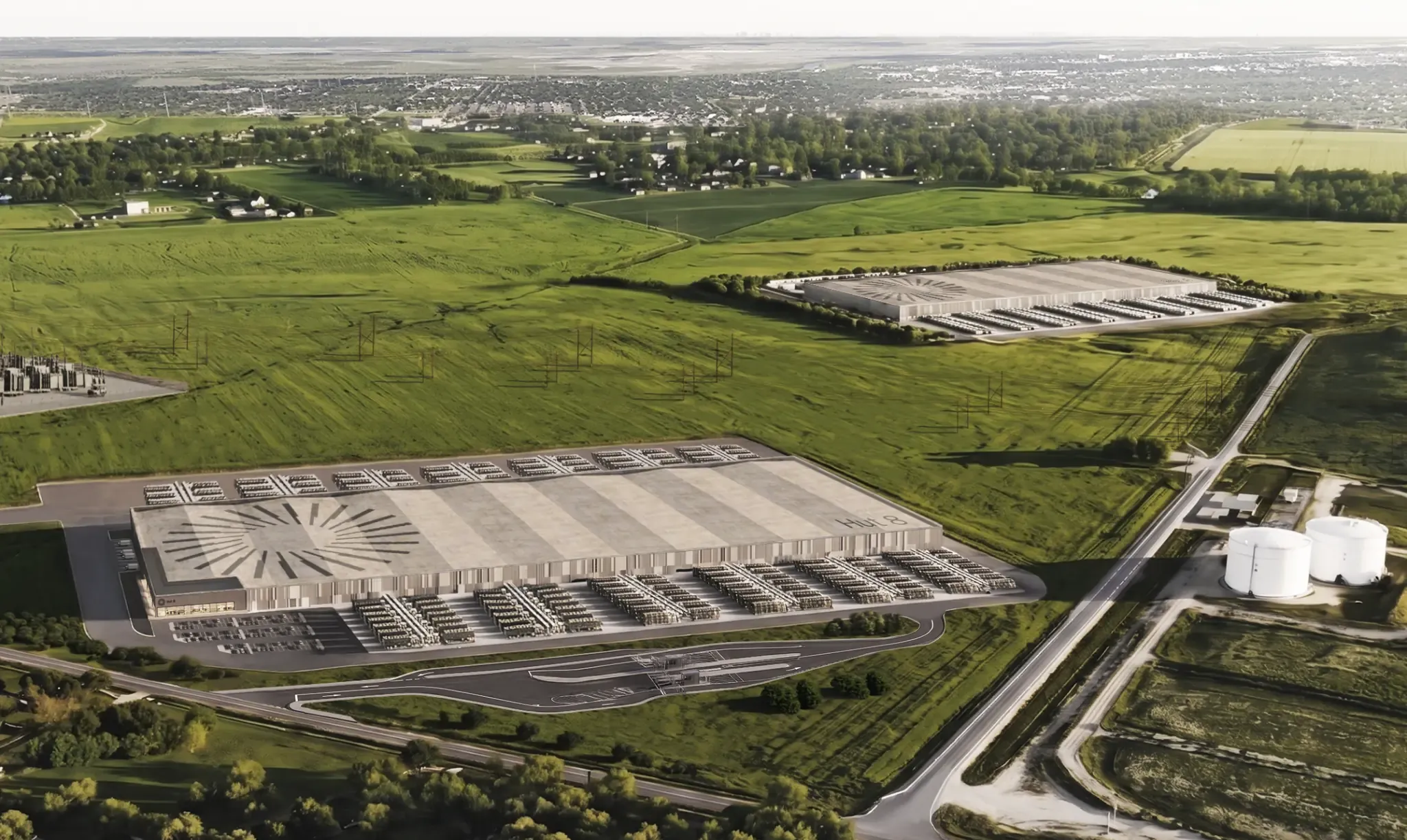
Beacon Point AI data centerA preliminary rendering of Hut 8’s Beacon Point AI data center campus in Texas. The development includes infrastructure designed around Nvidia technology as Anthropic pursues a reported $35 billion computing agreement with Nvidia-backed Lambda. (Image source: Hut 8)

Nvidia’s Role in the Infrastructure Deal

Nvidia hardware is central to the reported agreement, with Nvidia-backed Lambda expected to provide additional computing capacity for Anthropic’s Claude models.

Lambda’s role reflects the growing importance of specialized cloud providers that acquire advanced processors and offer the resulting computing power to AI developers. This structure gives companies such as Anthropic access to large amounts of capacity without requiring them to build and operate every data center themselves.

The arrangement brings together Anthropic as the reported customer, Lambda as the cloud provider and Nvidia as the supplier of the underlying computing technology. It also shows how demand for AI models is creating closer commercial links among developers, infrastructure operators and chipmakers.

AI Demand Reshapes Cloud Economics

The scale of the reported contract illustrates how access to computing infrastructure has become a strategic concern for companies developing advanced AI systems. Training and operating large models require extensive fleets of specialized processors, along with power, cooling equipment, networking systems and suitable data-center space. Those requirements increasingly translate into long-term commitments measured in tens of billions of dollars.

Anthropic’s infrastructure push extends beyond its reported agreement with Lambda. The company has also reportedly committed $45 billion to computing capacity at Nscale’s planned data center campus in West Virginia, adding another substantial long-term obligation to its expansion plans.

Large contracts can give AI developers access to hardware that remains difficult to secure, while providing data-center operators with the long-term revenue commitments needed to finance construction. They also create substantial future obligations.