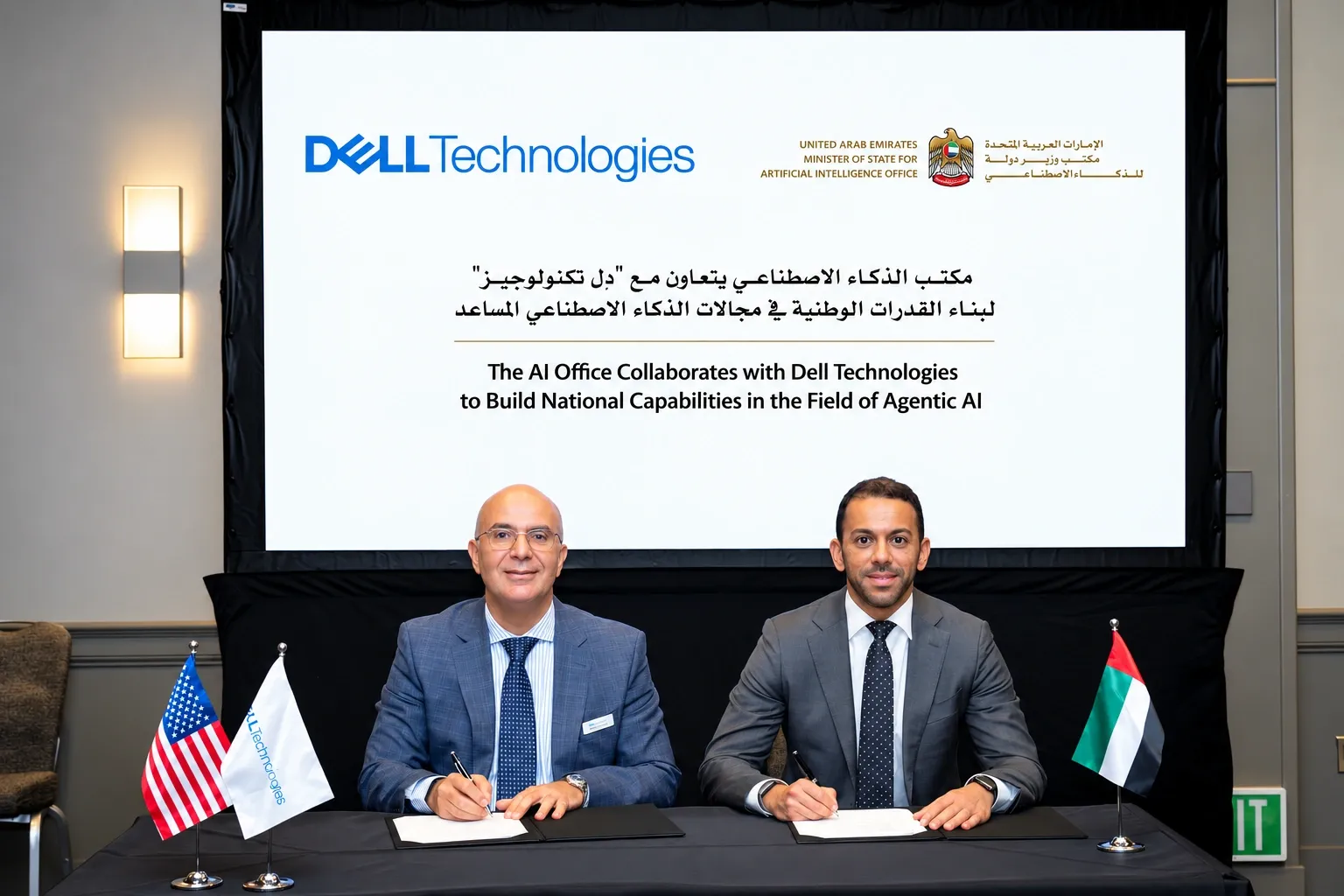
The UAE Government’s Artificial Intelligence Office has launched a strategic collaboration with Dell Technologies aimed at developing national capabilities in agentic artificial intelligence and moving more AI applications from experimental projects into government operations.
The collaboration will cover the development of AI prototypes and implementation-ready solutions, alongside specialized knowledge sessions for government entities.
Government entities taking part will also work with Dell Technologies on identifying practical AI use cases and designing strategies for deploying the technology. The initiative places particular emphasis on secure and flexible technology environments as government agencies consider how AI can be incorporated into existing operations and services.
From AI Experiments to Government Applications
A central part of the collaboration is the effort to narrow the gap between experimenting with AI and putting it into day-to-day use. Rather than focusing solely on demonstrations or early-stage concepts, the program is intended to support prototypes that can progress toward operational deployment.
Dr. Abdulrahman Al Mahmoud, Director at the UAE Government’s Artificial Intelligence Office, affirmed that the UAE adopts a proactive approach to leveraging artificial intelligence to develop the government work model, based on its wise leadership’s vision of the importance of building national capabilities and enhancing the readiness of government entities to benefit from rapid technological transformations and create more efficient and effective operating models.
Dell Technologies will contribute expertise spanning AI strategy, infrastructure and implementation. Walid Yehia, the company’s Managing Director for the South Gulf region, emphasized that the UAE has set a clear and ambitious vision to lead the next phase of artificial intelligence, noting that the real impact of these technologies lies in the ability to transform ambitions and ideas into practical, scalable applications and solutions.
The initiative arrives as governments and large organizations face a more difficult stage in AI adoption: moving projects beyond pilots while managing infrastructure, security, data and governance requirements. Dell itself has identified production readiness as an industry challenge, saying in a September 2026 analysis that security, compliance and data sovereignty are among the factors slowing enterprise AI deployment at scale.
Dell AI Factory Enters the Government Discussion
UAE officials were also introduced to the Dell AI Factory during the visit. Dell describes the platform as an approach that combines AI infrastructure, software, data, automation, services and partner technologies to support AI development and deployment.
The model is designed to help organizations move from testing AI systems to deploying them in production environments. The Dell AI Factory combines infrastructure, automation, professional services and a broader technology partner ecosystem to support a range of AI workloads.
Dell has been expanding the platform as enterprises look for ways to run increasingly complex AI workloads. In March, the company said the Dell AI Factory with NVIDIA had surpassed 4,000 customers, while announcing additional infrastructure, data platform and services capabilities. That disclosure relates to Dell’s broader customer base rather than the UAE collaboration.
Agentic AI adds another layer to those infrastructure requirements. Unlike conventional generative AI systems that primarily respond to individual prompts, agentic systems can be designed to pursue objectives through sequences of actions, interact with tools and data, and carry out parts of a workflow with varying degrees of autonomy. In a government setting, deploying such systems at scale can consequently raise questions around data access, security, oversight and accountability alongside their potential operational uses.
UAE Expands Its Agentic AI Push
The Dell collaboration forms part of a broader UAE government visit to the United States involving more than 50 chief AI officers and other leaders from federal and local government entities.
The Artificial Intelligence Office and Dubai Centre for Artificial Intelligence organized the visit to examine agentic AI technologies and deployment practices across technology companies and academic institutions. The itinerary includes engagement with companies including Dell Technologies, NVIDIA, Salesforce, Google, Snowflake, Databricks, AMD and Microsoft, as well as academic institutions.
The government has attached a concrete operational target to that work. The UAE is seeking to transform 50% of government sectors, operations and services into agentic AI-powered operating models within two years. The target puts the current round of industry engagement within a wider effort to build the skills, infrastructure and implementation knowledge needed for deployment rather than treating agentic AI as a standalone technology initiative.
That direction also builds on a national AI policy framework that predates the recent surge in generative and agentic AI. The UAE Strategy for Artificial Intelligence, first launched in 2017, calls for greater use of AI to improve government performance while developing the skills of public-sector employees. The UAE's National Strategy for Artificial Intelligence 2031 sets a broader goal of establishing the country as a global leader in AI by 2031.
Moving Toward Real-World Deployment
The latest collaboration gives UAE government entities access to Dell’s technical experience while creating a framework for testing where agentic AI can be applied in public-sector operations. Its immediate significance lies less in a single product deployment than in the shift toward identifying use cases that can progress into working government systems.
Security and governance will remain part of that process as more capable AI systems gain access to organizational data and tools. The UAE has already established broader principles around responsible AI through its Charter for the Development and Use of Artificial Intelligence, which includes privacy, data security and compliance among its principles.
The Dell initiative now brings those broader ambitions closer to the implementation stage. Prototype development, technical knowledge sharing and exposure to production-oriented AI infrastructure provide government entities with a route to test what agentic systems can realistically deliver.