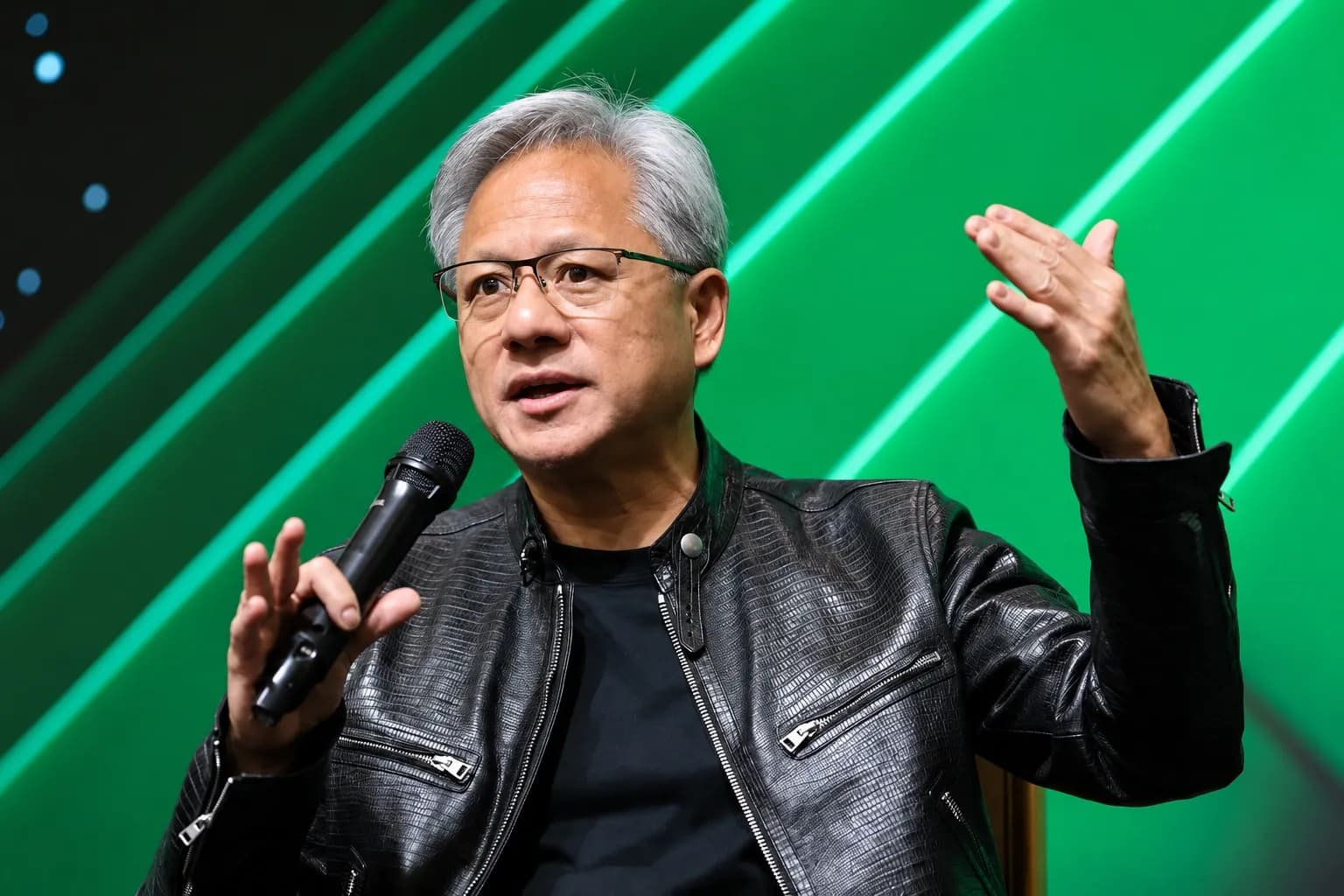
The disagreement also surfaced publicly at the All-In Summit in Los Angeles, where Huang received a phone call from President Donald Trump during an onstage discussion. Trump dismissed fears of an AI takeover as a “hoax” and said the United States should continue advancing the technology. The exchange occurred while Huang and the hosts were discussing calls to slow frontier AI development.
Huang later told CBS that he agreed with Trump’s rejection of end-of-the-world predictions. He also expressed support for applying existing laws to AI rather than treating catastrophic predictions as a reason to broadly restrain development.
Amodei Calls for a More Measured Pace
Anthropic CEO Dario Amodei has taken a different position on the speed of frontier AI development. In a September essay titled “We Must Pace the Frontier,” Amodei argued that AI capabilities are advancing quickly enough that safety work needs additional time to keep pace.
Amodei’s proposal does not call for an end to model training or technical progress. Instead, he advocates slowing the rate at which companies improve the capabilities of frontier models while directing more attention toward alignment, interpretability, operational safeguards and independent evaluation.
Speaking separately with CBS News, Amodei described AI development as following an “exponential” curve that is becoming steeper. He characterized that acceleration as a warning sign and argued that safeguards need to develop alongside increasingly powerful systems.
His proposed framework includes giving independent third-party evaluators continuing access to frontier AI developers, coordinating safety standards among companies in democratic countries and eventually pursuing international cooperation on advanced AI development.
The contrast with Huang is therefore narrower than a simple divide between supporting and opposing AI safety. Both executives have discussed safeguards, but they differ substantially over whether the speed of capability development itself should be constrained. Huang argues that companies can continue advancing rapidly while maintaining safety, while Amodei wants additional safeguards tied to a more deliberate pace at the frontier.
The Debate Reaches Beyond Silicon Valley
The disagreement carries implications beyond the companies building AI models. Businesses are increasingly incorporating generative AI and autonomous or semi-autonomous systems into software development, customer service, research, cybersecurity and other operations. How frontier systems are developed and regulated could influence the capabilities that eventually reach enterprise customers.
Nvidia also has a direct commercial connection to the continued expansion of AI infrastructure. Its accelerators are widely used for AI training and inference, placing the semiconductor company at the center of spending on data centers and computing capacity. That position gives Huang an influential voice in the debate while also giving Nvidia a substantial business interest in continued AI investment.
Anthropic approaches the issue from another part of the industry. As the developer of the Claude family of AI models, the company is simultaneously competing in the frontier-model market and arguing that developers should accept stronger mechanisms for evaluating increasingly capable systems.
The policy question is becoming more complicated as AI systems gain greater autonomy. Regulators and businesses are no longer dealing only with chatbots that generate text. Developers are building agents designed to use software, perform multi-step tasks and interact with digital systems with less direct human involvement, raising additional questions about testing, accountability and deployment controls.
Competing Views Shape AI’s Next Phase
Huang’s remarks make clear that he does not view catastrophic forecasts as sufficient justification for slowing the industry. His preferred approach centers on continued technological progress, adherence to safety requirements and enforcement of laws when products cause harm.
Amodei is pressing for a different balance. His proposal argues that capability gains are occurring quickly enough that the industry should create more room for safety research and external evaluation before systems become substantially more powerful.
Despite their disagreement over pace, neither position amounts to abandoning AI development or ignoring safety. The dispute is increasingly about timing: whether safeguards can evolve alongside rapid advances or whether the rate of capability growth itself needs to be moderated to give those safeguards time to catch up.