The United Arab Emirates and Lebanon have launched a large-scale initiative aimed at equipping one million Lebanese people with practical skills in generative artificial intelligence and prompt engineering, extending cooperation between the two countries into digital capacity building.
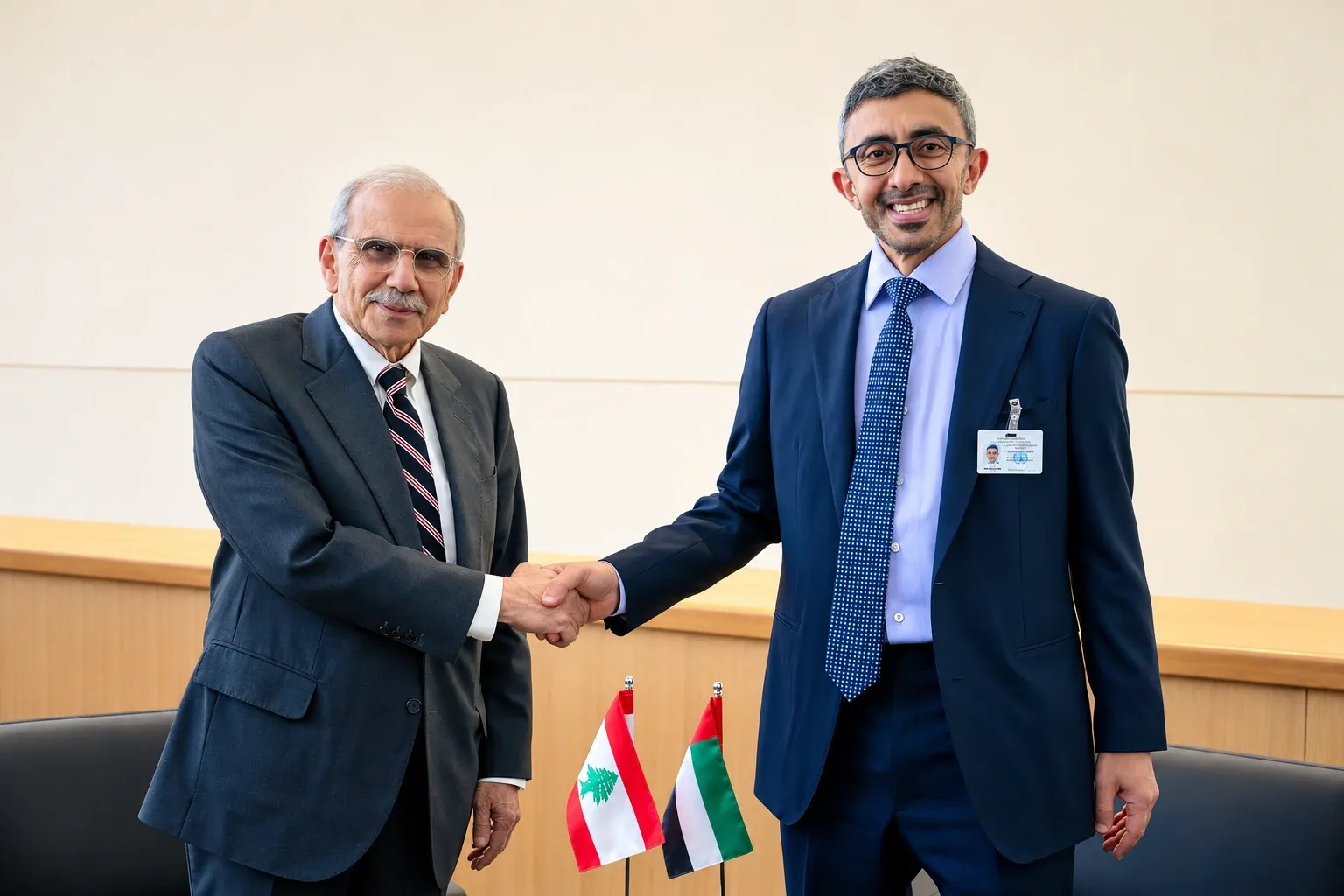
Called the “One Million Lebanese AI Experts” initiative, the program was announced during a meeting between UAE Deputy Prime Minister and Minister of Foreign Affairs Sheikh Abdullah bin Zayed Al Nahyan and Lebanese Prime Minister Nawaf Salam in New York. The meeting took place on the sidelines of the 81st session of the United Nations General Assembly.
The initiative will operate under the UAE’s Government Experience Exchange Programme (GEEP) in cooperation with the Lebanese government. Its focus is practical: participants are expected to learn how to use generative AI tools, formulate prompts and provide instructions that produce more accurate and useful results.
Building Practical AI Skills
The program is intended to reach people across different age groups, backgrounds and professional roles rather than being limited to technology specialists.
Prompt engineering forms a central part of the planned training. In practical terms, the skill involves structuring instructions and contextual information so generative AI systems can respond more effectively to a user's objective. The UAE announcement links those skills to completing tasks, raising productivity and developing ideas and solutions.
The scale marks a significant expansion from other digital-skills efforts already underway in Lebanon. Digital training has increasingly featured in development programs aimed at improving employment prospects and helping workers adapt to a changing labor market.
Lebanon’s Wider Digital Push
Lebanon enters the initiative with relatively high internet use but substantial economic and institutional challenges. A World Bank project document published in 2026 said internet penetration had reached 91.6% in early 2025, while mobile connectivity covered more than 80% of the population. The bank also pointed to growth in exWorld Bank project documentort-oriented technology businesses and AI-related activity despite the country's broader economic difficulties.
Digital skills are already a focus of development financing. In January, the World Bank approved $350 million in new financing for Lebanon across two projects covering social protection, economic inclusion and public-sector digital transformation. Of that total, $150 million was allocated to the Lebanon Digital Acceleration Project, which is intended to strengthen digital government infrastructure, cybersecurity, data capabilities and access to public services.
Separate efforts have focused more directly on employment skills. The World Bank's Digital Skilling for Employment project, approved in January 2026, seeks to expand access to market-relevant digital skills and income-generating opportunities among vulnerable young people. Its project documentation allocates about $1.15 million to digital skills for employment and $2.72 million to productive inclusion in the digital economy, including microwork.
Those programs are separate from the new UAE-Lebanon initiative, but they illustrate the wider emphasis being placed on digital capabilities as Lebanon looks for employment and productivity opportunities that can operate beyond the constraints of its domestic economy.
UAE Expands Knowledge-Exchange Model
The initiative also extends a model the UAE has used to share government practices and technical expertise internationally. The UAE government's official portal describes GEEP as a platform for exchanging government-development and modernization expertise with partner countries.
Its areas of cooperation have included government services, leadership and capacity building, human resources, entrepreneurship and programming. The program has previously supported technology-training initiatives such as One Million Arab Coders and country-level adaptations of large-scale coding programs.
The Government Experience Exchange Office, established within the UAE Ministry of Cabinet Affairs in 2023, oversees knowledge-exchange partnerships and capacity-building initiatives with other governments. The office also follows the implementation of exchange programs and assesses their outcomes.
Applying that framework to generative AI represents a shift toward a technology that is increasingly being used outside conventional software-development roles. Rather than concentrating solely on coding, the Lebanese initiative emphasizes the ability to interact with AI applications and use them in routine professional and personal tasks.
The AI initiative was announced as Abdullah and Salam discussed broader relations between the UAE and Lebanon, including opportunities to strengthen cooperation across different sectors.
Abdullah reiterated the UAE's support for efforts to strengthen security and stability in Lebanon and for the country's development. The AI program adds a human-capital component to that relationship, with knowledge and technical skills forming part of the two governments' cooperation.