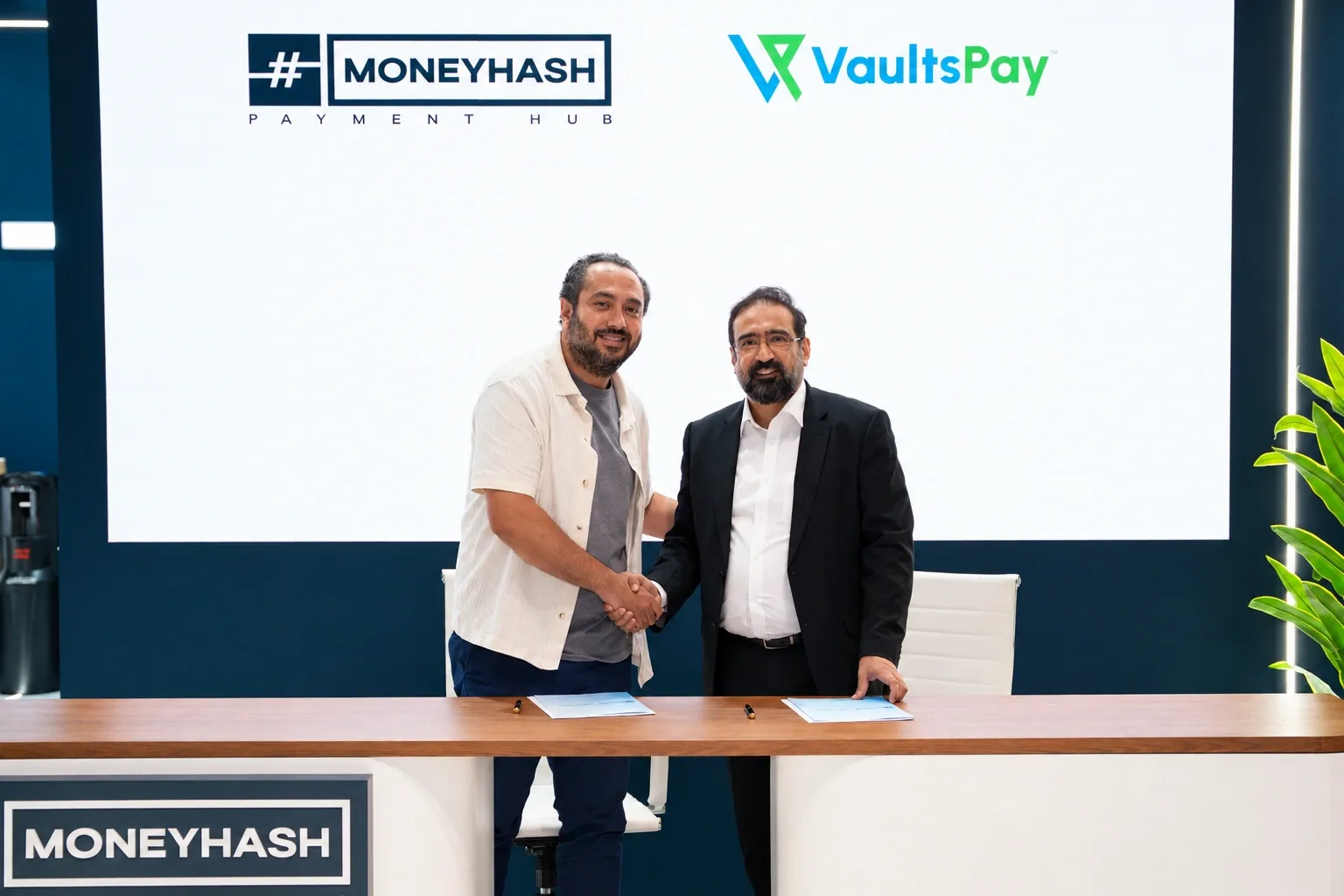
MoneyHash has partnered with UAE-based payment provider VaultsPay, adding another option for businesses that manage their payment providers through its platform. The agreement allows merchants to incorporate VaultsPay into their existing payment arrangements while retaining centralized management.
The companies say the connection removes the need to build and maintain a separate, standalone integration with VaultsPay. Businesses using MoneyHash can instead manage the provider alongside other payment services within the same infrastructure. The companies marked the partnership at Seamless Middle East 2026 in Dubai.
Nader Abdelrazik, MoneyHash’s co-founder and CEO, said: “The value of orchestration is not simply connecting businesses to more payment providers. It is giving them the infrastructure to make those providers work together as part of one payment strategy. Adding VaultsPay to our ecosystem strengthens the payment capabilities available to businesses in the UAE, while giving them the flexibility to manage those capabilities alongside the rest of their payment stack.”
Sailesh Malhotra, CEO of VaultsPay, added: “As businesses expand across channels and markets, they need greater flexibility in how they build and manage their payment infrastructure. Our partnership with MoneyHash brings together VaultsPay’s payment capabilities and MoneyHash’s orchestration infrastructure, giving merchants more choice and control over their payment strategy. Together, we aim to help businesses simplify payment management, respond to changing customer expectations, and build a stronger foundation for long-term growth across the UAE and beyond.”
How Merchants Manage the Connection
MoneyHash supplies payment orchestration software: infrastructure that allows businesses to coordinate multiple payment providers through a common technical connection. Its payment infrastructure materials describe a system built around a single application programming interface, or API, and a central dashboard.
An API allows software systems to exchange instructions and information. In this setting, the shared connection gives a merchant a way to access supported payment services without developing every provider connection separately. The merchant-facing infrastructure and the underlying payment provider perform different roles within that arrangement.
MoneyHash’s developer documentation lists tools for setting payment routing rules, retrying transactions, and switching between connected providers. It also describes transaction notifications, checkout tools, and testing environments.
The documentation includes hosted checkout options and software development kits for web and mobile applications. Those tools address how businesses incorporate payments into their customer experience, while routing and transaction notifications address how payments are handled and monitored behind the checkout.
A shared integration still leaves implementation work for merchants. MoneyHash’s documentation includes API keys, testing, and transaction handling, while VaultsPay’s website sets out its own merchant onboarding process.
VaultsPay’s Services Across Sales Channels
VaultsPay lists online payment pages, payment links, QR payments, recurring billing, and e-commerce integrations among its business services. It also offers point-of-sale equipment for transactions conducted in person.
These services address different ways businesses collect payments. A payment link can be sent to a customer by email or text message, while a hosted payment page provides an online checkout destination. Recurring billing supports repeated collections, such as subscription payments, rather than requiring a new payment request for each billing cycle.
The provider’s in-person offering includes mobile point-of-sale devices, cashier systems, and unattended terminals. Its published product range therefore extends beyond website checkout to physical sales environments.
VaultsPay describes merchant onboarding as a sequence involving account creation, identity verification, and payment-method setup. That process indicates that access to its services involves more than choosing a provider from a software menu; businesses must also complete the provider’s applicable account requirements.
Addition Follows Another Regional Agreement
The VaultsPay partnership follows MoneyHash’s September 24 announcement with Geidea. That agreement also centered on allowing businesses to access a payment provider through their existing MoneyHash integration.
MoneyHash said the Geidea connection would give merchants access to its online payment gateway and supported payment methods across the UAE, Saudi Arabia, and Egypt. The announcement described a similar approach to integration: incorporating another provider into a shared payment setup instead of maintaining a separate connection.
The two agreements show MoneyHash continuing to add regional providers to its network. Their stated geographic scope differs, however. The VaultsPay announcement focuses on UAE payment capabilities, whereas the Geidea release explicitly identifies access across three markets.
The latest addition gives merchants another provider to evaluate within MoneyHash’s infrastructure.