The United Arab Emirates and Argentina have opened negotiations toward a Comprehensive Economic Partnership Agreement, bringing trade policy into a relationship that is already developing around a major liquefied natural gas project.
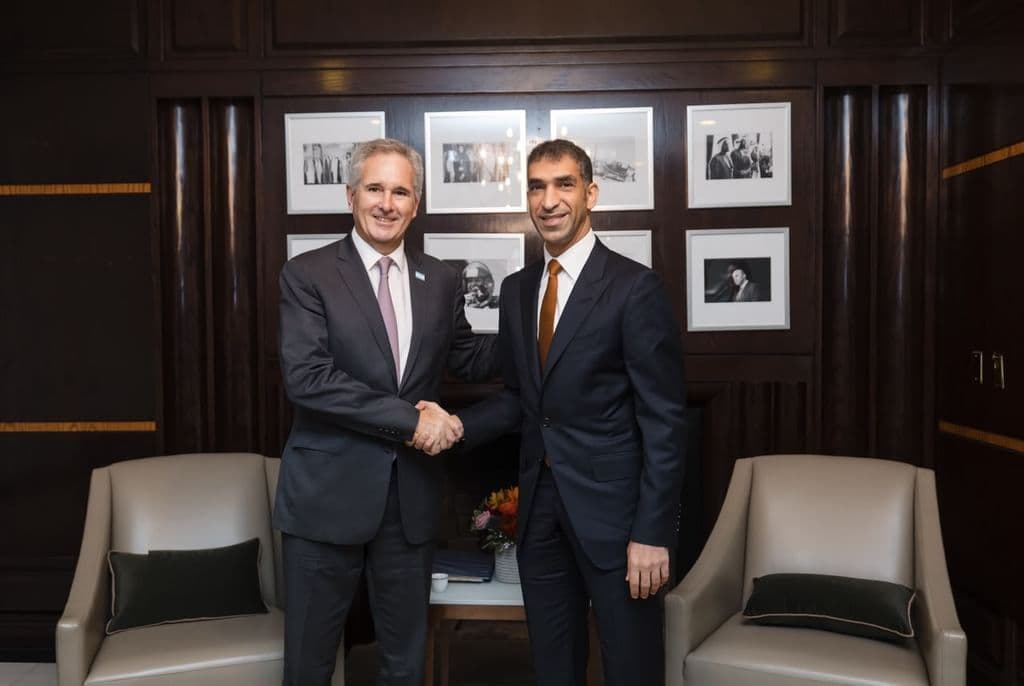
UAE Minister of Foreign Trade Thani bin Ahmed Al Zeyoudi and Argentine Foreign Minister Pablo Quirno announced the talks after meeting in New York on September 24, on the sidelines of the United Nations General Assembly. Their joint statement calls for accelerated negotiation.
The ministers also pointed to the partnership between Argentina’s YPF and XRG, the international investment arm of Abu Dhabi National Oil Company, as an example of the investment they hope to encourage. That partnership is part of Argentina LNG, a project whose developers estimate total spending of about $51 billion over its lifetime.
A Trade Agenda Beyond Energy
The proposed agreement would seek to expand market opportunities for goods and services. The two governments identified mining and minerals, artificial intelligence and data centers, pharmaceuticals, energy, agribusiness, aerospace, tourism, infrastructure, real estate and urban development as areas of interest.
The list reaches well beyond commodities. It brings sectors such as pharmaceuticals and aerospace into the same trade discussion as agriculture and tourism, giving the two governments several avenues for cooperation alongside their growing energy ties.
Argentina and the UAE already have a bilateral investment treaty and an agreement to avoid double taxation in force. Both ministers cited those arrangements as part of the existing framework for investment and trade. A CEPA would add a new agreement to that relationship if the negotiations succeed.
How the LNG Project Fits In
Argentina LNG is designed to turn natural gas from the Vaca Muerta formation into exports through two floating liquefaction facilities off the coast of Río Negro. The initial plan calls for a combined capacity of 12 million metric tons of LNG a year, with room for later expansion.
The three project partners, YPF, Italy’s Eni and XRG, signed a joint development agreement in February. That agreement set out work on engineering, commercial arrangements and financing ahead of a final investment decision. It marked progress on the project, but did not itself amount to a decision to fund and build the entire development.
Their cooperation deepened in June when YPF announced agreements to bring Eni and XRG into the upstream company intended to hold gas blocks dedicated to Argentina LNG. Under the proposed ownership structure, Eni and XRG would each acquire 32%, while YPF would retain 36%. YPF said completion remained subject to conditions, including a relevant regulatory approval.
The governments’ decision to cite this project gives the trade talks a concrete commercial backdrop. The CEPA negotiations and the LNG development remain separate processes.
Investment Plans and Open Questions
YPF put the $51 billion estimate into greater detail when Argentina LNG applied in August to enter Argentina’s Large Investment Incentive Regime, known as RIGI. The company said the amount represents projected spending throughout the project’s life, with approximately $29 billion expected by 2031, its projected startup year for the two floating LNG units.
Of that earlier spending, YPF estimated about $24 billion for infrastructure, including pipelines, industrial facilities, port works and the floating units, and roughly $5 billion for upstream development and wells. The company said it expects to use international project financing during construction, supported by long-term export agreements with buyers. These are plans and estimates, rather than completed expenditures.
YPF has also projected approximately $10 billion in annual export revenue over two decades once the project is operating. The scale of the projections helps explain why the LNG venture featured in the ministers’ statement, while the remaining engineering, financing and investment decisions show how much work lies ahead.