@2026 Finance News International. All Rights Reserved.

Blends Media
A Blends Media Group Production

Alibaba Unveils Qwen4-Max Flagship, Says It Cuts AI Task Costs by About 60%

Arry Hashemi
Arry Hashemi
Nov. 17, 2026
Radar chart comparing Qwen4-Max and Qwen3.8-Max scores across Work360 industry categoriesAlibaba says its new Qwen4-Max AI model cut the time needed to program a part for machining from nearly eight hours to 24 minutes in a company demonstration. (Shutterstock)

Hangzhou, China — Chinese technology group Alibaba has released Qwen4-Max, a 2.4-trillion-parameter artificial intelligence model that it says outperforms its predecessor on an in-house industry benchmark while lowering the average cost per task by around 60%.

Alibaba describes the new release as the most capable model in the Qwen family so far. It handles images natively, accepts a context window of one million tokens and is aimed at complex jobs in business, creative production and research, according to the company.

Qwen4-Max can be used now on QwenCloud, under the Token Plan or through the API, and inside Alibaba's own products, including QwenWork and QwenStudio. Alibaba lists input with an implicit cache hit at $0.075 per 1 million tokens. The official Qwen account on X announced the launch the same day.

Cost sits at the center of the pitch. On Work360, a benchmark Alibaba built itself to test challenging industry tasks in 721 specialized fields, the company said Qwen4-Max scored higher overall than Qwen3.8-Max while consuming 35% fewer tokens in its High effort reasoning mode. Because Work360 is Alibaba's own test, the results are the company's assessment rather than an independent one.

The company credits the improvement to a new Qwen4 architecture, which reworks its sparse Mixture-of-Experts (MoE) design across attention, residual connections and embeddings. In this kind of model only part of the network is switched on for each token, and Qwen4-Max draws on 71 billion of its 2.4 trillion parameters at a time. Alibaba said that is 25% fewer active parameters than Qwen3.8-Max at the same 2.4 trillion size, giving stronger results at a lower inference cost.

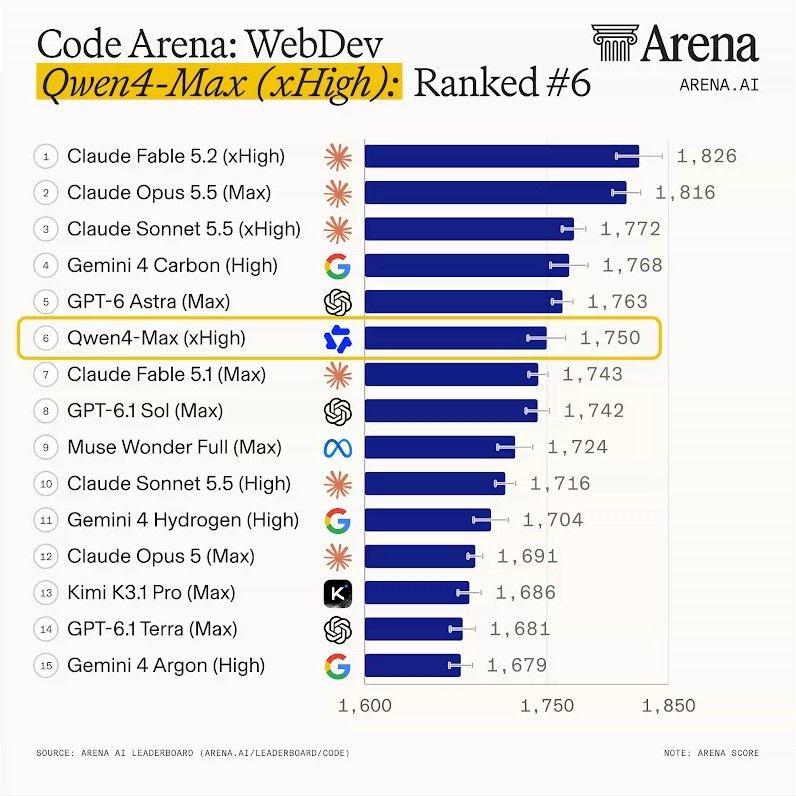
On public leaderboards, the model placed 6th on Code Arena, which ranks systems on real-world coding work, Alibaba said. It also pointed to strong showings on tests of agent workflows, workplace productivity and visual reasoning, naming Agents' Last Exam, Vals Index, JobBench and Chartography, though the release does not give scores for those four.

Alibaba is also selling the model as a tool for running the cloud itself. Qwen4-Max includes Cloud Resource Scheduling functions built for cloud deployments, which let it adjust its own scheduling workflows in a closed loop to save money and use resources more efficiently. In benchmark tests, the company said, this lowered the cost of data-annotation model calls by an average of 9% and made offline CPU rescheduling more than 14 times faster.

Outside the data center, the company listed 3D modeling, game development and agentic video creation among the professional and creative uses. In automotive manufacturing, it said the model can take on production-line planning, part design and machining verification from end to end. During one showcase, manual workpiece programming fell by 95%, from roughly 475 minutes to 24 minutes, as the model used feedback-driven iteration to spot overcuts and insufficient material removal before any machining began.

Qwen4-Max ranked 6th on Code ArenaAlibaba’s Qwen4-Max placed sixth on Code Arena, a leaderboard that compares how AI models perform on real-world coding tasks. (Image source: Alibaba)

Alibaba added that Qwen4-Max speeds up forward-deployed engineering (FDE) in industries including finance, law and healthcare. The release does not name any customers using the model in those sectors.

Science is the other target. Alibaba says Qwen4-Max is designed for agents that run around the clock, using long-horizon planning to connect digital research with physical experiments. Working on cooling for next-generation chips, Qwen4 ran as an agent for 48 hours straight and went four times through a closed-loop workflow of molecular design, synthesis and testing, and active learning, ending with a coolant molecule that was validated by experiment.

In a separate Alzheimer's research experiment, the model covered target research, molecular design and computational evaluation from start to finish. Over that workflow it carried out 454 tool calls and 3,239 metric evaluations on its own to design and refine 24 candidate molecules, according to the company.

Alibaba said it builds model governance into the whole life cycle of its models. During software engineering training, code security checks ran next to functionality tests, which the company said sharply reduced flaws such as injection, memory safety and broken access control weaknesses.

Training data for cybersecurity tasks was screened by intent, the company said, so material that helps detect and fix vulnerabilities stayed in while offensive attack content was taken out. Dedicated safety datasets and post-training work add further protection against chemical, biological, radiological and nuclear (CBRN) risks.

The launch follows the debut of Qwen3.8-Max on August 3. That model also had 2.4 trillion parameters and a context window of up to 1 million tokens but activated 95 billion of them, and Alibaba said at the time that it ranked fifth in Text Arena and second in Vision Arena. Qwen4-Max went into preview on Alibaba's Token Plan on November 11, according to a post from the Qwen account on X.

AI is now the main growth engine in Alibaba's cloud results. In the quarter to June 30, 2026, revenue from its AI Cloud and Compute Services segment rose 45% year over year to $7.14 billion (RMB 48.44 billion), and AI-related product revenue reached $1.82 billion (RMB 12.38 billion), a twelfth straight quarter of triple-digit growth, according to the group's June quarter results.

The model side is still loss-making. AI Labs and Applications, the segment that brings together Alibaba's AI model labs, the Qwen Consumer Business Group and QwenWork, posted an adjusted EBITA loss of $2.04 billion (RMB 13.86 billion) in the same quarter, more than four times its loss a year earlier, on revenue of $492 million (RMB 3.34 billion). In February 2025, Alibaba committed to invest at least $53 billion (RMB 380 billion) in cloud computing and AI infrastructure over three years.

A lower cost per task could matter to enterprise buyers, including financial firms, that pay for AI by the token and may weigh price and efficiency as heavily as leaderboard rank. Chinese developers are also a growing part of the field: Stanford HAI's 2025 AI Index counted 15 notable AI models from China released in 2024, against 40 from the United States.

Alibaba said smaller open-weight models from the Qwen4 series will soon be released to developers worldwide, but it has not given a date.